US Debt History

Here we are at the end of September and the threat of a government shutdown, which is very likely to be realized in a few days, dominates much of the news landscape.  Of course, most aspects of American politics are deeply polarized but the subject of a shutdown seems to ratchet up the rhetoric even higher.  The are many aspects of contention between the various factions but one item lies firmly in the economic sphere, namely government debt.

The first debt the country would end up carrying was a result of the expenses incurred in fighting the Revolutionary War to its successful conclusion in 1783.  After the establishment of the Constitution in 1787, this debt became a point of contention between the Northern States, which most held it, and the Southern States, who did not want to assume it as a joint debt of the combined union.  The Compromise of 1790 resolved brought the two sides together with the South agreeing to make the debt held at the federal level and North, who conceded the permanent location of the national Capitol in Washington D.C., located on the border between Maryland and Virginia.

During the ensuing 232 years, the debt has fluctuated up and down in response to various exigencies experienced by the country.  Since inflation lowers the purchasing power of a fixed amount of money the usual way to track the debt is as a percentage of gross domestic product.  This will be the sole measure used in this discussion.

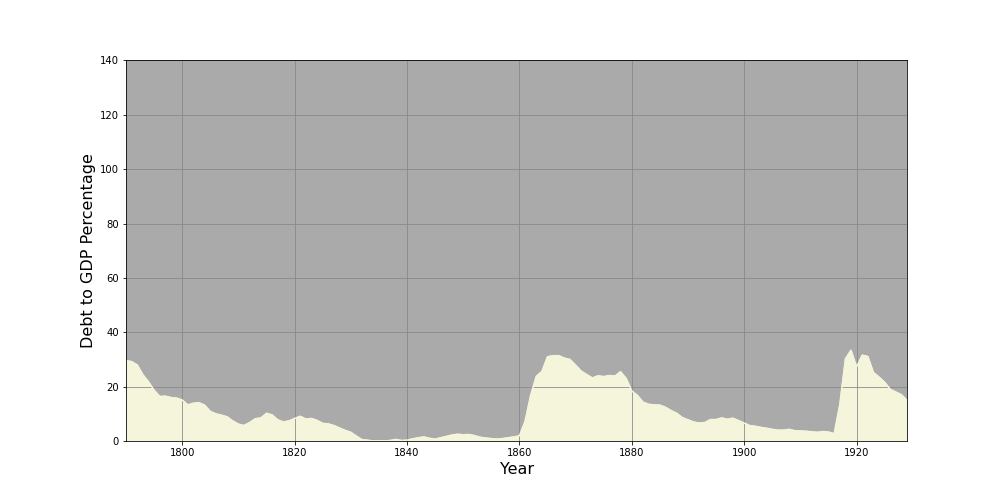
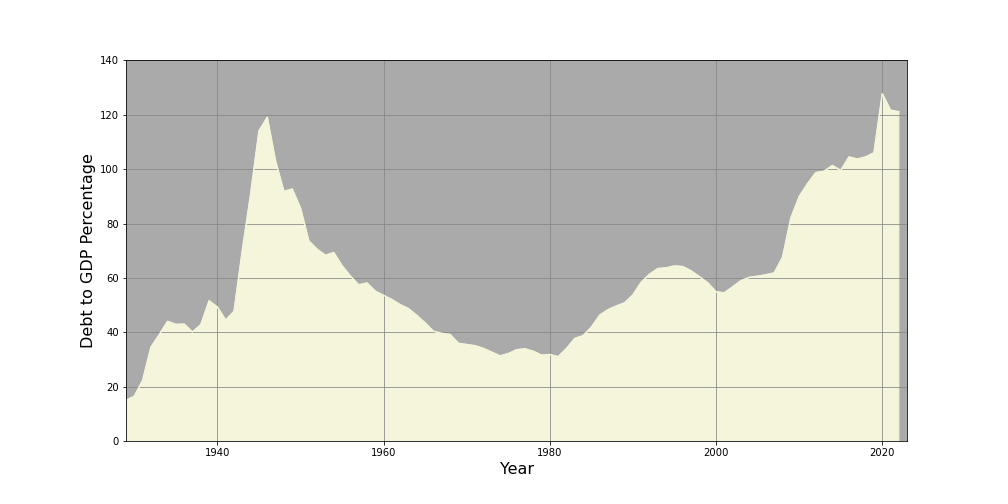
Historical data for the time span of 1790 to 2000 is available from the Congressional Budget Office (CBO).  Those data were combined with data from 2000-2022 available from the St Louis office of the Federal Reserve.

Over the time span from 1790 (debt inception) to 1929 (year of the bank panic), the percent of debt to GDP never went above 40% and the three increases are all associated with a major war:  the first peak from the original debt from the Revolutionary, the second due to the Civil War, and the third in and around World War I.  The average debt held during this period of time was approximately 11.2%.

Over the time span from 1929 to 2022 (the last full year with reportable statistics), the ratio of debt to GDP only went below 40% on two occasions.  The first is in the period of time from the bank panic in 1929 to the most serious part of the Great Depression in 1933.  The second is from 1967 to 1984 during the tumultuous economic times of the 1970s.  From 1992 to 2007, the ratio hovered around 60% but then shot up rapidly after the Great Recession, most likely due to the increased government spending associated with quantitative easing that was employed during that time period as means of addressing the aftermath of the housing market catastrophe.  The level increased again to its current level during the time of the pandemic.  The average debt held during this time period was approximately 60.8%.

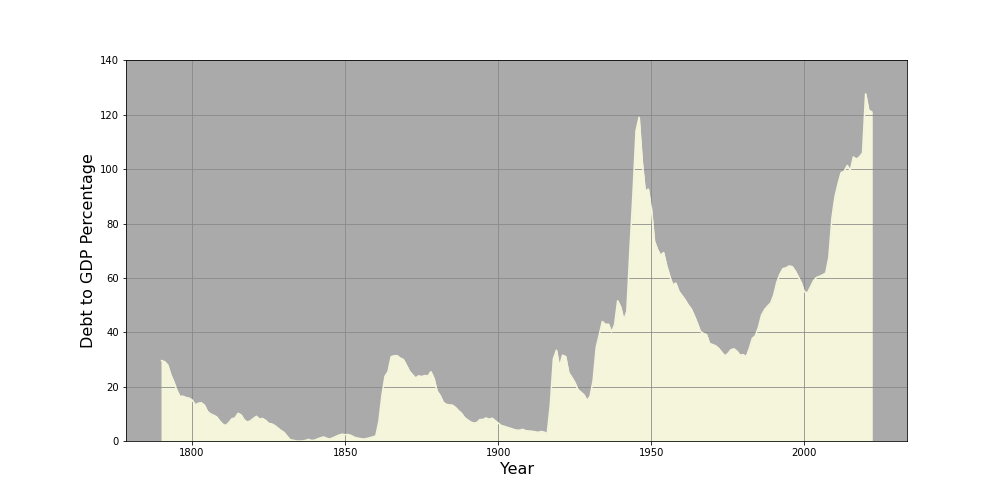
Obviously, there was a fundamental shift in governmental fiscal policy in the 139 years prior to the Great Depression when compared with the 92 years following.  This fundamental shift is most easily seen in a plot of the entire time range.

Debt to GDP has never been as high as it is now, not even during World War II, when the country faced an existential threat.

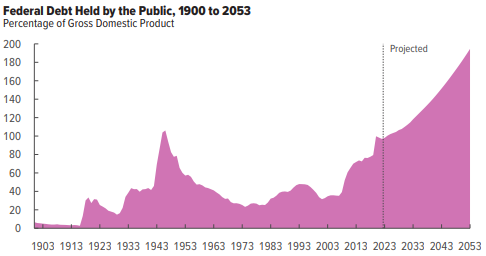
So, the key question is: are we getting our money’s worth from all this spending?  Proponents point to the amazing standard of living we enjoy – in particular, to the various entitlement programs aimed at protecting the most vulnerable amongst us and to the highly technological and productive work force we employ who generate the material wealth even the poorest of us commands.  Opponents point to the numerous examples of waste and fraud, the inefficiencies, and, ultimately, to what they perceive as the unsustainable trajectory US debt is on.  The following plot from the CBO underscores their concerns.

Unraveling these arguments to find the truth is difficult because arguments on both sides often involve hypotheses contrary to fact fallacies.  Perhaps with a more laisse-faire approach to the economy we would be enjoying a greater standard of living than what we have now with a far smaller fraction of people below the poverty line.  Perhaps more spending is exactly what is needed to jump-start growth and lower poverty.

That said, I find the arguments made by men like Thomas Sowell and Milton Friedman compelling.  These economists base their arguments on careful time-based and lateral studies that, while not completely free of counterfactual reasoning, come as close as any social scientist can to objective studies of the economy that parallel how physical scientists study nature.  They argue quite persuasively that the ratio of debt to GDP is too high to bring benefit to the average citizen.  Sadly, neither their arguments nor, for that matter, the arguments of economists supporting the opposite viewpoint are presented in a comprehensive way to the public.

Where exactly will the debt debate land?  At the time of this writing, it isn’t clear at all what will happen next, but whatever does it is likely to involve more sound bites than sound arguments.


Drama, Humor and Economics

It’s rather easy when talking about economics to get lost in the ‘science’ side of the dismal science.  Charts and graphs, tables of numbers, calculations of marginal utility and opportunity cost – all of these things can sometimes blur the social side.  But the social side is where the drama and the conflict and the humor and the warmth and the real people with real feelings live.  So, with an eye towards the very ‘social idea’ of the summer blockbuster, it seemed appropriate to look at some additional examples from the popular arts were the story, be it serious or humorous, lay.  This month’s offering can be thought of as one of those ‘flashback episodes’, so common on episodic television when both budget and schedule were biting (although neither are active here), where a mix of old and new material is there to enjoy.

Broken Window Fallacy

One of the first deep economic thinkers to follow in the footsteps of Adam Smith was Frederick Bastiat. Bastiat wrote against lazy economic thinking and is most famous for refuting the broken window fallacy, which erroneously states that destruction is useful for an economy.  This position is whimsically examined in the following scene from the movie The Fifth Element.

The actual, logical refutation looks at opportunity costs and is brilliantly presented by Bastiat in his 1850 essay That Which We See and That Which We Do Not See and is further amplified in the earlier blog Save the Economy: Nuke a City.

Principal-Agent Problem

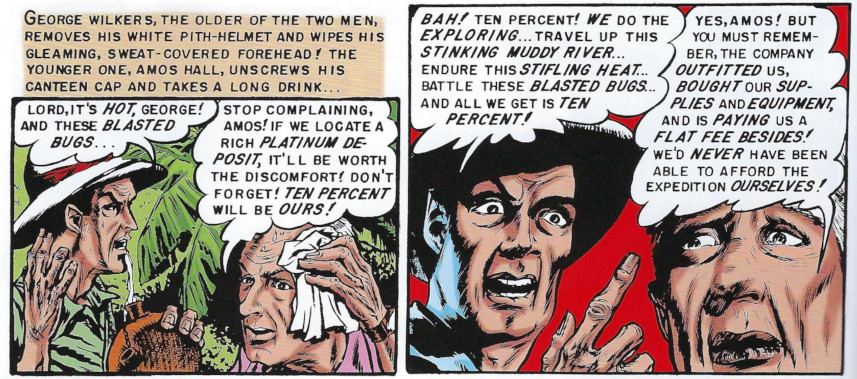
The principal-agent problem is the economic phrasing to describe the resentment that often arises between the entity funding an activity (the principal) and the entity being paid to follow through on an activity to completion.  It is an essential backdrop in almost every employment scenario and hinges on the devaluation by one side of the efforts of the other.  The example here is taken from the story A Tree Grows in Borneo published by EC Comics in Crime SuspenStories #9, in 1952.

Two small panels manage to succinctly convey the central conflict – a conflict familiar to each of us even if the economic labeling is not.

Moral Hazard

A moral hazard is an economic incentive that tends to promote riskier behavior because the person enjoying the incentive is now relieved from the need to bear the full cost of the risk himself.  Common in the insurance market, the full scope, and humor, of the hazard is brilliantly on display in John Joseph’s Rental Car comedy bit.

Adverse Selection

“Adverse selection occurs when, due to a lack of information (called information asymmetry), the wrong type or class, defined as having characteristics not well suited to the demands of the market, is favored by the incentives of the market.”  That very dry quote from an earlier post (Adverse Selections and Moral Hazards) hides the drama found whenever a transaction is offered or sought where trust is needed.  The following scene, from the movie It’s a Wonderful Life, illustrates this for the $8000 loan sought by the hero of the story, George Bailey, from the town’s bank, Mr. Potter.

Of course, Potter is cast as a miserable, wicked miser but the questions he asks are still valid.  Does the borrower really have the need he claims and will he use the money for the intended purchase.  And the borrower also has the question about just what type of person is the lender.  Of course, the movie as a whole is a wonderful study in the economics of the financial markets.

The Fallacy of the Labor Theory of Value

One of the most important and central points of economics is that value is not an objective measure but depends on the situation and on the preferences of the people involved.  Much of this topic is covered in depth by the earlier post Value and Trade but it is worth pointing out that there is often a lot of comedy surrounding this undeniable truth – a truth that most people, nonetheless, deny when it applies to them and their particular situation.

In our first clip, we find the bumbling Broadway producer Max Bialystock in the aftermath of the opening night of his musical about Hitler and World War II.  Looking to put on a surefire flop so that he could scam a fortune from his invester pool of little old ladies, Max is left pondering how things could have gone so right.

For our final look at the concept of value in the popular arts, consider the oft-mismatched newlywed couple of Paul and Corie Bratter in Neil Simon’s wonderful play/movie Barefoot in the Park.  Corie, the free spirit, has secured their first marital home on the 5th floor of a building with 6 flights (everybody counts the front stoop) and no elevator.  The apartment, consisting mostly of 2 rooms and a bathroom (with no tub), comes complete with drab walls, no heat, and a hole in the skylight that will let them see the city’s first snowfall of February before anyone else does.  When Paul gets his first look at it (he only saw the model on the third floor) he is clearly disappointed.  Corie, using all her persuasive charms, tries to convince him that “it will be beautiful” until a surprise visit by her mother changes the tenor of the conversation from sultry to panicked.

Having convinced Paul to lie to her mother that the rent is $75.63/month, including gas and electricity, we have a to wait a bit before we see Paul in action.  As Corie sends Paul out to get some scotch and cheese to entertain their guest, Corie’s mother ask Paul how he likes his new home.


So, there you have it.  Despite what is often dry and boring analysis, there lurks under the exterior of all economics the exciting stuff of life – a little drama, a little humor and all of it definitely human.

California Burning

In his book How to Lie with Statistics, Daryl Huff points out that misleading statistics are used so often by members of the fourth estate that it is difficult to truly believe that it is due to happenstance and a poor understanding.  It seems more likely that the use of misleading statistics to sensationalize is deliberate, although proving it so is impossible.  In this way, there is overlap between his observations with that old maxim

Once is happenstance.  Twice is coincidence.  Three times is enemy action. – Ian Fleming, Goldfinger

So too goes for the law of unintended consequences, where a new maxim of economics might be read as

Once is happenstance.  Twice is economic ignorance.  Three times is active subversion.

What brings this grim pronouncement to this month’s column?  Once again, the Wise of Sacramento have created a set of incentives that they claim will help the average California resident, but which are subverting the insurance market in the golden state.  Large insurers are either scaling back (Chubb and AIG) or are refusing to issue new homeowner policies altogether, as is the case with State Farm and Allstate, California’s 1st and 4th largest insurers of residential property.

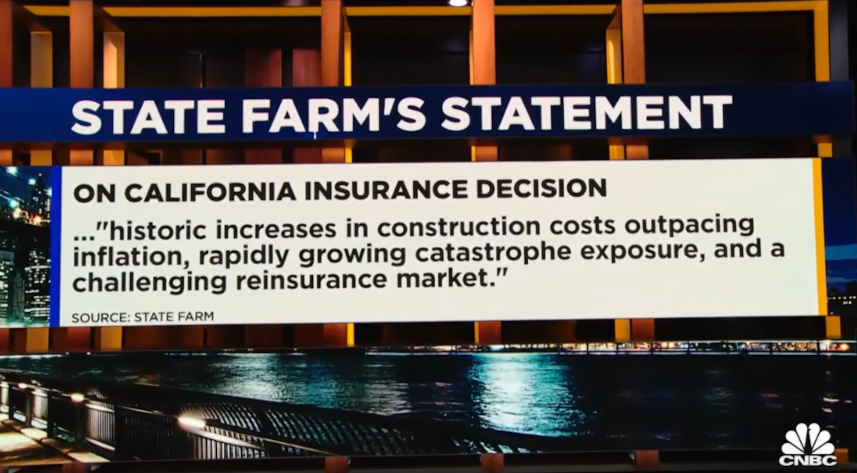
To be fair, in their press announcement, State Farm cited three reasons for their discontinuance of new policies: 1) increasing wildfire risk, 2) rising home construction prices that outstrip inflation, and 3) a challenging reinsurance market.

Can all of these woes be laid at the feet of governance?  Well, while California’s state legislature is not entirely responsible for the first two items, they are certainly not blameless.

In his article Of Course Home Insurers Are Fleeing California, Mark Gongloff, of Bloomberg, points out that California ‘NIMBYism’ has driven non-affluent residents to build in higher risk areas.  Once these homeowners are established in this high-risk zones, the state does little to protect them from wildfires as the CNBC’s host of the discussion and analysis in the video Insurance is the effect not the cause, says III CEO Kevelighan on State Farm's California decision points out:


Regarding the construction costs Gongloff points out that

the only people who can build or rebuild in such places are those wealthy enough to afford skyrocketing premiums and fire-resistant construction materials and techniques. The result is “gentrification by fire,” as the Washington Post termed it.

This, in effect, favors higher-end construction costs state-wide, an outcome that Sacramento seems quite content to ignore.

But the most damning indictment against California governance is its insane regulatory structure.  While the state legislature does little to curb estate development costs it seems quite comfortable in exercising its regulatory muscle to force insurance companies to keep costs artificially low.

In her article Why insurance companies are pulling out of California and Florida, and how to fix some of the underlying problems, Melanie Gall, Co-Director of the Center for Emergency Management and Homeland Security, Arizona State University, poses the question

So, why did State Farm and Allstate only stop new policies in California and not in other wildfire-prone states like Colorado or Arizona?

The obvious answer to this is California’s proposition 103 that limits premium increases to homeowners, prohibit policy cancellations and require certain levels of coverage, all of which effectively eliminate ways in which the insurers can mitigate risk from the consumer side.

According to Gall, the chief executive of the insurance company Chubb’s

…mentioned restrictions that left it unable to charge “an adequate price for the risk” as part of the reason for its 2022 decision to not renew policies for expensive homes in high-risk areas of California.

Steve Forbes, in his video California's Insurance Catastrophe Explained—How Government Caused Another Crisis | What's Ahead, puts the matter much more forcefully, blaming the regulatory structure imposed on the states insurers as keeping premiums artificially low.


This sentiment is shared by Gongloff, who writes that

California has one of the lowest home-insurance rates in the country, as a percentage of median household income — less than Georgia and West Virginia, according to Bankrate data.

Insurance Information Institute CEO, Sean Kevelighan, in a clip from the CNBC video cited above, lists the numerous issues that Proposition 103 turns a blind eye to.


The damage caused by California’s heavy-handed regulatory structure doesn’t end there.  As Gall points out,

California also has a unique “efficient proximate cause” rule that forces property insurers to also cover post-fire flooding, such as mudslides. Rainy winters like 2023’s often trigger destructive mudslides in wildfire burn areas.

The consequences (unintended or otherwise) of such perverse incentives is that insurance companies know full well the actuarial risk they are being forced to take but can do little to share that risk with the home owner.  As a result, they are also impeded in getting reinsurance, which Investopia defines as insurance for insurers, which transfers risk to another company to reduce the likelihood of large payouts for a claim, thereby allowing insurers to remain solvent by recovering all or part of a payout.

Gall cites the rising costs of reinsurance by noting that

Reinsurers’ risk-adjusted property-catastrophe prices rose 33% on average at their June 1, 2023, renewal, after a 25% rise in 2022, according to reinsurance broker Howden Tiger’s analysis.

And, so, we find that rather than expose themselves to additional risk that could conceivable bankrupt the company, insurers are simply opting out.  The consequences of this move are far-reaching.  This leaves California as the insurer of last resort through their FAIR plan, which provides basic fire insurance coverage for properties that can’t secure policies through traditional means.

Once again, Steve Forbes pulls no punches in his assessment of the scope and financial soundness of the FAIR plan.

Of course, one might think that Sacramento would change course when confronted with all of this overwhelming evidence of how California’s regulatory structure is causing more harm than good.  But, one would be wrong.  The prevailing sentiment seems to be one in which ‘greedy’ businesses are blamed for not being good corporate citizens and must be forced businesses into doing things against their financial well-being, as Gongloff notes:

The advocacy group Consumer Watchdog demanded that state Insurance Commissioner Ricardo Lara drag State Farm back into the market, claiming he has the authority under California’s Proposition 103.

Sadly, this debacle is only one battle in an ongoing, subversive war which California governance seems to be waging against common sense and the citizens of a once great state.  Enemy action indeed.

Writers' Drama

In a plot twist that clearly shows how life can imitate art, the behind-the-scenes makers of theatrical productions have now become the main characters in a real-world, economic drama.  The cause of this unscripted bit of theater centers around the current strike by the Writers Guild of America (WGA) that began on May 2, 2023.  One part melodrama, one part farce, this work stoppage came after the WGA failed to come to terms with the Alliance of Motion Picture and Television Producers (AMPTP), which represents over 350 studios and production companies in collective bargaining agreements with the various trade unions of the entertainment industry.  And while the stakes of this particular drama are not particularly high – just a tangible threat to this fall’s TV lineup and a stagnation of new shows on the streaming service instead of the specter of world-shattering oblivion as is usually the case in a script – the tensions and competing points-of-view offer a compelling look at the laws of supply and demand, how technology changes and shapes the employment landscape, and ultimately, labor/management relations.

At the heart of the WGA’s complaint are three concessions they want from the AMPTP to address issues that have arisen from how streaming services, such as Hulu and Netflix, have negatively impacted the landscape for writers: a) steadier work, b) bigger residuals, and c) no AI-generated scripts.  In order to appreciate the underlying economic impacts, we’ll have to introduce and then compare and contrast the two competing models for how television shows are produced: the network model and the streaming model.  The description of these models that follows is based largely on Vox’s video How streaming caused the TV writers strike.

In the traditional network model, new shows or seasons premiere in the early fall and typically end in the late spring comprising about 22 shows distributed over 40 weeks of production, on average, a season (although there is a substantial spread around that average, especially as function of time).  In the modern streaming model, services like Hulu and Netflix order a fixed number of shows typically 8 or 13 and air them (i.e., drop them) whenever they see fit for the benefit of the subscribers.  Since television shows, regardless of content or venue, involve multiple, episodic stories linked within a common framework, the creative responsibilities are shared by a team who gathers, either in person or virtually, in what is called the writers’ room (although it is often called the development room in the formal legal documents).

On the positive side, the larger scope of the network model provides writers with steadier employment for an entire year and, because the writing is done concurrently with filming and editing, this approach also offers ample opportunities to involve the writers in the production in addition to the conceptual stages.  On the negative side, this model can only support about 80 shows given the bandwidth associated with broadcasting on one of the four major networks.  In addition, writers are required to adapt their craft to the need to hold an audience during the commercial breaks (usually 5) during the course of the show.

In contrast, the positive side of the streaming model supports roughly 450 shows per year and generally allows writers far more creative control as there is no need for commercials as the audience bears the cost of the shows production through their purchase of a subscription plan.  On the negative side, the size of the show order is much smaller and streamers generally want the scripts completed before production begins precluding the chance of writers to be involved in production.

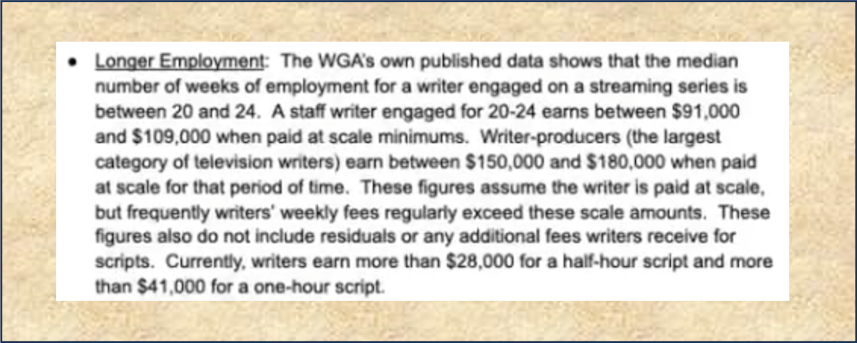
The basic rate for a writer is the same regardless of under which model the writer performs his or her work.  A reasonable floor value is roughly $5,000 per week as shown in the AMPTP’s formal response to the WGA’s claims.

The number of writers that might work on a show is tougher to gauge but 20 is a reasonable number and it is also reasonable to assume that a vast majority of writers work only one show at a time.  With these facts in hand, we can do a little economic analysis.

  Network Model Streaming Model
Number of Shows 80 420
Number of Writers per Show 20 20
Number of weeks 40 20
Total Number of Writers 1,600 8,400
Total Cost of Capital (millions) $320 $840


It is important to recognize that these are estimated costs of capital which form a lower bound to what the studios actually pay to employ the 11,500 members of the WGA.  The true costs are no doubt higher and will be likely higher still given the following proposed concession by the AMPTP.

According to the Vox video, the growth in streaming has been over the last 15 years.  During this same time period, the US population has grown by about 12%.  Ignoring other considerations, such as inflation and the proliferation of alternative sources of entertainment (e.g., YouTube, videogames, etc.), the capital cost of writers over that same time period has increased by a factor of 3.6.  This is the reason that the WGA finds itself at odds with AMPTP – there is a surplus of entertainment on the market.  The situation is even more dire when one figures in the drop subscriber growth streaming services are suffering and the fact that network and cable viewership is dropping.

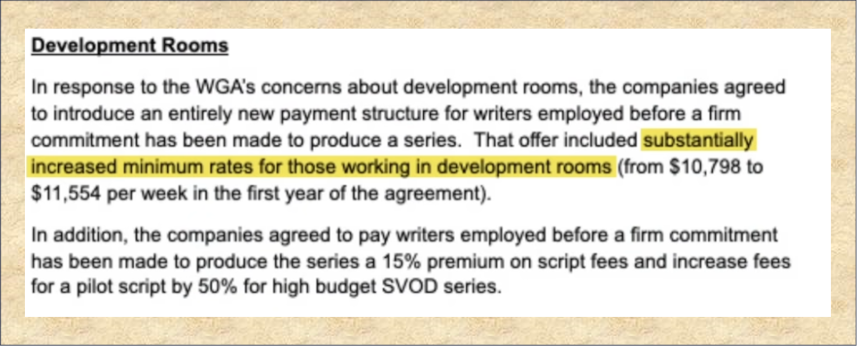
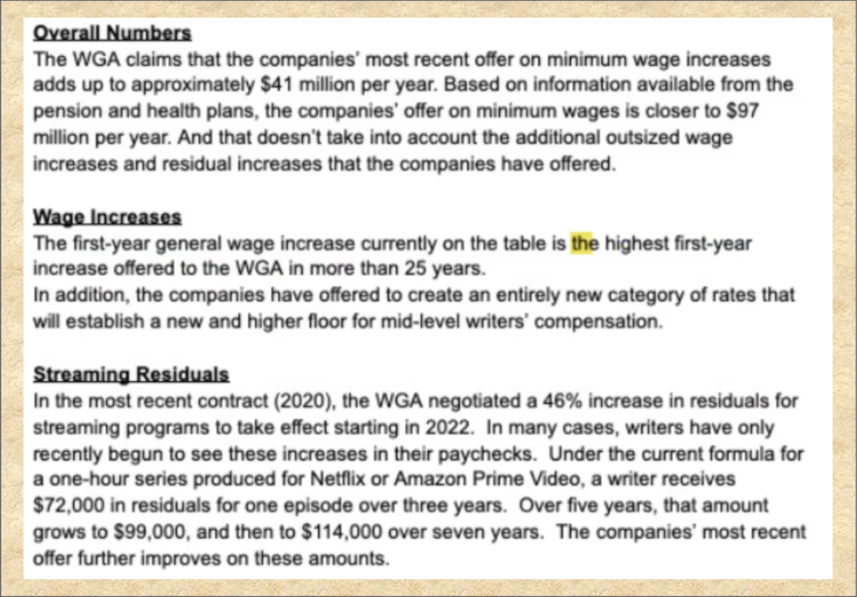
The WGA’s second demand only puts the squeeze on this situation even more.  They are demanding higher residuals, which are basically additional income based on subsequent revenues obtained by the studio for additional viewings.  Under the network model, the popularity of the show is known via the ratings system precisely because that information is used to set advertising rates.  Under the streaming model, there is no incentive for a company such as Netflix to publish the number of times a show is watched and the linkage between a given show and a customer beginning or maintaining his subscription is tenuous at best.  Nonetheless, the WGA has demanded concessions from the AMPTP for greater residuals to which the AMPTP issued the following response.

The third and final of the WGA’s point concerns the use of generative artificial intelligence to produce derivative scripts. The article 'Plagiarism machines': Hollywood writers and studios battle over the future of AI by Dawn Chmielewski and Lisa Richwine of Reuters, has a nice quote by screenwriter John August, who states the WGA position as stating the concerns as: "We don't want our material feeding them, and we also don't want to be fixing their sloppy first drafts."

The fact that the WGA made this concern a part of its bargaining is far more troublesome than it might seem at first glance since it clearly means the studios represented by the AMPTP don’t see the value in the writers that they see in themselves.  Most likely the WGA thinks that the studios are greedy and that their executives want to enrich themselves at the expense of the ‘real talent’ but those very same executives recognize that they need good scripts to attract viewers; their very greed means that they value the one thing that make them money – stories that get eyes on screens.  Sadly, these same executives don’t see a risky downside in replacing humans with machines and that should worry the WGA more than they are publicly letting on.  Major story debacles, such as the widely panned end to the Game of Thrones series, no doubt have done little to get public opinion on their side and their own insensitivity in saying that they are impoverished when they only make $100,000/year in Los Angeles must fall on deaf ears in a county where the cost of living is one of the highest in the country and the median household income is just under $80,000/year.  This strike is unlikely to end soon and the outcome is likely to be a tragedy for many of the nations writers.


A Little Too Ironic

Most everyone knows the song Isn’t It Ironic by Alanis Morissette and a large fraction of those who do cannot only sing along but can quote the various scenarios verse-by-verse, even after the song is over.  Fewer of us seem to know or care that Morissette’s song, as catchy as it may be, is far from being semantically correct.  All of the vignettes she covers are really instances of bad luck.  Rain on your wedding day is only ironic if you’re marrying a weatherman who predicted earlier in the week clear skies for the nuptial day.  And finding 10,000 spoons when all you need is a knife sounds more like a common problem usually encountered in the dying hours of a picnic with store-bought plastic dinner wear.  And the internet is virtually no help in this department either as the word ‘ironic’ is, perhaps ironically, one of the most misused words.

Now, before any despair sets in that somehow this column has switched from matters economic to matters ironic, let me just assure everyone that a recent exchange on the state of the US economy between Chris Hayes and Bernie Sanders could very well be the poster boy for how irony should work.  According to Wikipedia, Eric Partridge writes that “irony consists in stating the contrary of what is meant” and the ridiculous exchange between Hayes and Sanders as to why the American Dream is more out of reach for the middle class than ever certainly meets the bill.

To summarize the speech, Hayes opens with the ‘paradox of capitalism’: that while so many things have gotten cheaper (cell phones and TVs), the ‘pillar core of the middle-class life’ – 1) owning a home, 2) securing health care, and 3) sending one’s children to college – have become much more expensive.  Bernie retorts that the reason that US lifespans have gone down, even before COVID, is the ‘enormous stress’ middle class households are under trying to afford these basic ingredients.  The pair, in both the lead up and in the follow-on to the clip above state in both word and tone, in explicit and implicit content, that the obvious thing is for government to step in and make these ‘pillars’ affordable again (e.g., Biden’s attempt at student loan forgiveness, a new nominee for Labor Secretary, etc.).  And here is where the irony attaches.  Each of the three pillars mentioned have become much more expensive because of, not in spite of, government intervention.

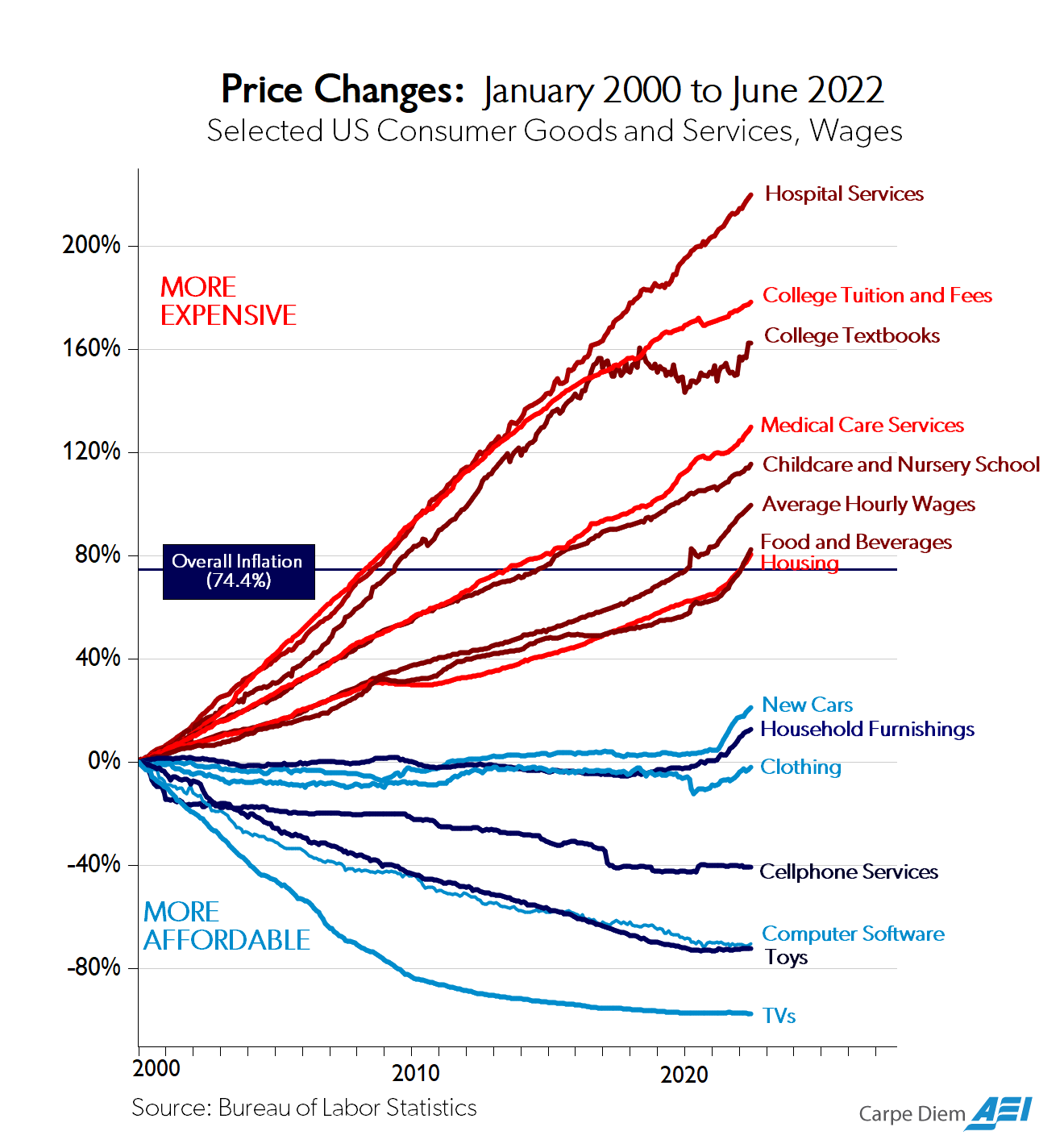
The simplest way to illustrate this assertion is by looking at the cumulative inflation by economic sector plot produced by the American Enterprise Institute (AEI).

The curve labeled ‘Average Hourly Wages’ (hereafter wages) is the yardstick against which we measure standard of living of the middle class as follows.  In approximately 2011, wages had risen by 40% from their levels in January of 2000.  Likewise, by approximately 2020, wages had risen 80%.  In those same years ‘Hospital Services’ were approximately 95% and 195% higher than their January 2000 values.  The ratios of these two values show that hospital services were approximately 2.3 times more expensive than wages.  Since the hospital services curve and the wages curve were both roughly linear, this means that over this 20-year span, the middle-class standard of living versus a stay in the hospital remained always around a constant 2.4-to-1 ratio.  Assuming linearity (well supported on the ‘Hospital Services’ curve but not so much on the ‘Average Hourly Wages’ curve), we can conclude that the middle class neither found a stay in the hospital to become more or less expensive of these 20 years, all other things being equal.  Of course, all other things are not equal, so the impact of an expensive hospital stay when other things are going up in relative price is important but not something that is easily teased out of the plot.

Armed with this way of mining data from the plot above, let’s note a few global things.  First, any curve with a local slope that is growing relative to the slope of the wages curve over the same time span means that the middle class is losing ground in that sector – in other words, middle-class purchasing power is decreasing for that good and the middle-class standard of living is decreasing.  Second, one can find reflections of recent current events in the data.  For example, one can see that from January 2000 to late 2008 the wages curve and the curve labeled ‘Housing’ sat on top of each other.  After that point, housing took a sharp dive, and a gap between wages and housing was established.  At around mid-2011, housing again began growing at the same rate as wages but with a constant offset.  Of course, these patterns reflect the tumultuous events in the housing market after the whole sub-prime lending debacle.

Returning to Hayes and Sanders, we can see that they were factually correct but wrong in diagnosing the cause and the cure.

For their first pillar, we can see that the steady offset that persisted for over a decade between wages and room & board (‘Housing’ and ‘Food and Beverages’) has recently narrowed, with the slope of the latter two curves becoming greater since early 2021 with the onset of the ‘transitory inflation’ (perhaps another irony) caused by the Fed expanding the money supply.  This last statement is strongly supported by the sharp uptick in the ‘New Cars’, ‘Household Furnishings’, and ‘Clothing’ curves, which otherwise show decreasing cost over the plotted time span.

For their second pillar, health care (considered as the aggregate of ‘Hospital Services’ and ‘Medical Care Services’), much of the analysis was already done above.  The middle class has held a roughly steady offset against these curves of about 2.4-to-1 and 1.8-to-1, respectively.  Note that both health care curves are very nearly linear despite the passage of the Affordable Care Act in 2010.

For their third and, thankfully, final pillar, education of children, there are several ways we can aggregate the data.  The middle class has, until recently, held the same ground relative to college (the ‘College Tuition and Fees’ curve) as it did to hospital services; namely in a 2.4-to-1 ratio.  Starting around 2015 the slope of the college curve seems to have dipped while the wages curve has increased slightly, suggesting that, while still very expensive, a college education is starting to become slightly more affordable.  Likewise, childcare (the ‘Childcare and Nursery School’ curve) has, until recently, held itself in a 1.8-to-1 growth ratio relative to wages, similarly to ‘Medical Care Services’. (Side note:  leveling of and wild fluctuations in the ‘College Textbooks’ curve starting in the mid-2010s is due to students now being able to buy Pearson international editions on the grey market or finding PDFs of the textbooks online and so that particular sector is in a lot of churn.)

All the red curves that contribute to the three pillars show marked increase in costs as a function of time, and all fall within highly regulated sectors of the economy in which the government limits, either by action or inaction, strong competition.  In those sectors largely unregulated by government, we find the blue curves showing marked decrease in cost, in an absolute sense, creating an increase in middle-class purchasing power in these sectors.  This is why a family of four may have problems getting health care but can have a TV streaming Netflix in every room.

So, there you have it.  Two stuffed shirts babbling on, without any sense of irony, about how more government is the cure to illness caused by government.  Perhaps we can convince Ms Morissette to revise her iconic song with a new verse reading


An old man, socialist by name,
Talked to a pundit about US shame
Government, they said, would fix all our woes
Never admitting that their ideas were our foes
Isn’t ironic…

March Banking Madness – Part 2, What to do Now

Last month’s post looked at the causes of the various bank failures that dominated the March news cycles well-beyond the financial circles and which penetrated general news cycles and everyday discussions held at work and over the dinner table.  The reasons for these failures were a combination of exposure to the weakness to cryptocurrencies in the wake of the FTX failure coupled with inadequate hedges against rising interest rates.  In the case of Silvergate, that bank voluntarily began liquidation in advance of shuttering and the size of the overall assets that were affected is rather small.  In the case of Credit Suisse, an agreement was reached with UBS to save the bank though the latter’s purchase.  However, two of these banks, namely Silicon Valley Bank (SVB) and Signature Bank, were liquidated and sent into receivership making them two of the largest bank failures in US history.  The following table, adapted from Wikipedia’s list of the largest banking failures in the US, shows that they occupy the second and third place on the all-time list, when adjusted for inflation.

Bank State Year Assets at time of failure ($B)
Nominal Inflation-adjusted (2021)
Washington Mutual Washington 2008 $307 $386
Silicon Valley Bank California 2023 $209 $209
Signature Bank New York 2023 $118 $118
Continental Illinois National Bank and Trust Illinois 1984 $40.0 $104
First Republic Bank Corporation Texas 1988 $32.5 $74
American Savings and Loan California 1988 $30.2 $69
Bank of New England Massachusetts 1991 $21.7 $43
IndyMac California 2008 $32.0 $40
MCorp Texas 1989 $18.5 $40
Gibraltar Savings and Loan California 1989 $15.1 $33

Okay, these failures were big.  In fact, SVB and Signature bank failures come in at the second and third on the list and, in combination, are almost as large as the holder of first place.  So, the next point is obviously what should be done about these.

Ordinarily, in the event a bank fails, the Federal Deposit Insurance Corporation (FDIC) will step in a restore depositors up to a ceiling amount of $250,000 dollars per account.  But in the case of SVB, reports state that over 90% of its depositors were well over that mark, most of the accounts being associated with business to meet payroll.  However, the US Treasury Department, the FDIC and the Federal Reserve, announced in a joint statement that depositors in both banks would be made whole.  Supposedly, this restoration will be done without no cost being passed on from the financial sector according to the article U.S. government steps in to shore up deposits at Silicon Valley Bank and another failed institution by CBS News:

Depositors with SVB "will have access to all of their money starting Monday, March 13. No losses associated with the resolution of Silicon Valley Bank will be borne by the taxpayer," the statement said,

but it is very difficult to see how this can be true.  Even if the costs are not passed directly onto bank consumers, the financial institutions that supply the funds will cut back in other areas.  To quote an old adage: there is no such thing as a free lunch.

Included in the arguments for making the depositors at these banks whole are the facts that: failures of this size pose a systemic risk to the economy; the depositors, being primarily businesses, need to have large sums of liquidity available for payroll, and so can’t reasonably have accounts below the FDIC maximum; that the depositors weren’t responsible for the bank mismanagement, and so on.

I am certainly sympathetic to the arguments concerning the depositors and I am willing to agree that they had no knowledge or culpability in the mismanagement of these institutions and that the $250,000 ceiling, while perhaps viable for a household account, is entirely inadequate for a business.  But I am deeply opposed to the systemic risk argument.

That type of argument is simply another way of repackaging ‘To Big To Fail’.  A host of moral hazards follow in its train.   The first, and maybe most obvious, moral hazard is that making depositors whole lowers the incentive that they, and others like them, will call for societal change in how banks are run.  To give an example of how this lack of incentive might work, consider the fact that for the last 8 months of its existence SVB went without a risk manager and that the regulators knew that.  If each of the clients are made whole there will be no outcry, no demands, no lawsuits, etc.  It will be just a quiet return to the status quo with no outrage fuel calls for change that might actually work.  Future institutions will be given an implicit green light for more risky chicanery while government regulators will be excused from their inaction and invited to being even more hands off.

The second, less obvious but more important moral hazard is that bailing out the depositors provides a set of perverse incentives concerning their behavior.  Bank customers will again be lulled into being ill-informed about the financial institutions that they trust, picking a bank based more on getting a free toaster than on the soundness of the institution (full confession – I never thought about investigating the soundness of a bank until now).  But far more concerning is that this ‘bailout’ now provides a strong incentive for depositors to gravitate to the big banks (e.g., Bank of America, Chase, Wells Fargo, Citi, etc.) thinking that there is an implicit governmental promise of being made whole.  This is the very point that Senator Lankford makes in his question of Treasury Secretary Janet Yellen.

As depositors being to get that message that ‘To Big To Fail’ benefits them as much as it does the financial firms and regulators, choices in banking will dimmish.  Community banks will begin to disappear and, with what is essentially a regulatory imprimatur, the larger institutions will have no incentives to manage risk.  Eventually, there won’t be enough bailout funds and the entire system will collapse.  That is the argument against making the depositors whole.

March Banking Madness – Part 1, How it Happened

March Madness! That phrase is the usual rallying call of the NCAA men's basketball tournament each March.  Millions of people idle away hundreds of hours filling in brackets, watching the games, and crying about how one upset or another ruins their chances of winning it all.  But this month, we saw a different kind of madness, one whose origin is in financial not educational circles and whose ‘upset’ threatens more than just bragging rights and modest windfall from the office pool:  the sudden spate of bank crises that have captivated headlines throughout this month.

It all started in early March with the announcement of a voluntary liquidation by Silvergate (3/8/2023), followed by the failures of Silicon Valley Bank (SVB) (3/10/2023) and Signature Bank (3/12/2023), and topped with the news of the forced acquisition of Credit Suisse by UBS (3/19/2023). If one were superstitious, one might suppose that the fact that all these bank crises involve firm whose name beging with the letter ‘S’ (Credit Suisse means Swiss Credit in English) is just the way that the universe selects the banks to fail much in the way that people select NCAA Tournament winning teams by uniform color or mascot name.  In fact, it isn’t superstition but rather underlying rules of economics which led to these failures, even though each has as its proximate cause that is somewhat different from the others.  The following table summarizes the proximate causes and points to additional resources (Wikipedia (W) and/or the appropriate video(s) by Patrick Boyle and Plain Bagel (v)) for further explanation and unpacking.

Bank Proximate Cause of Crisis Additional Resources
Silvergate Bank run caused by downturn in the cryptocurrency market following the dissolution of FTX, one of their largest customers, resulting in a 70% loss in deposits and exposure to an unhedged interest rate risk
SVB Liquidity crisis due to poor risk management of interest rate vulnerability and a bank run
Signature Bank Closed by the New York State Department of Financial Services due to its exposure to the downturn in the cryptocurrency market
Credit Suisse Liquidity crisis triggered by inopportune language by one of its large investors coupled with its ‘bad boy’ reputation

In the case of the three US banks, exposure to cryptocurrency and an either direct or indirect vulnerability to interest rate changes are, in essence, what caused their collapses.  Building on the analysis of Patrick Boyle (e.g., Bank Runs! What's Going On?), these banks found themselves, like other institutions, awash in deposits during the pandemic.  Some of this great influx of cash was due to pandemic relief measures that were perched on the Federal Reserve’s expansion of the money supply and some of it was due to the lowered economic activity as most people endured lockdowns.

Once a bank sees a marked influx of deposits, the next question is what to do with them.  A bank’s job is to act as an intermediary to get unused capital from party A into the hands of capital-deprived party B; that is to say, they need to invest the available funds in the forms of loans.  The number of initial public offerings and other start-up loans having fallen off left these firms looking for other places to invest.   Since interest rates were effectively zero, these firms decided to invest their deposits in a mix of risky cryptocurrency, for their potential upside gain, and in long-term bonds, for their risk-free return and ability to meet the capitalization requirements each bank must comply with.  This this might have been a safe strategy had not the Federal Reserve began diddling the economy by increasing the money supply and then by raising interest rates in a vain attempt to tamp down inflation.

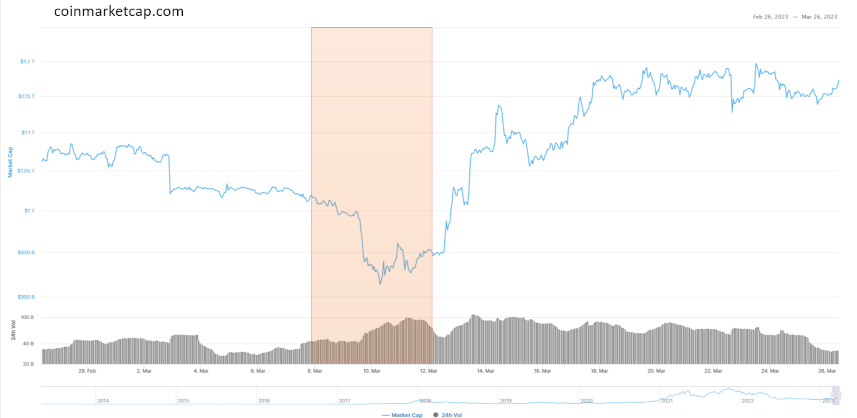
When FTX collapsed last October there was a strong pressure for many depositors to exit their crypto positions.  The following graph from coinmarketcap.com shows how the overall crypto market capitalization fell by roughly 10% over the days from March 8th to March 12th.

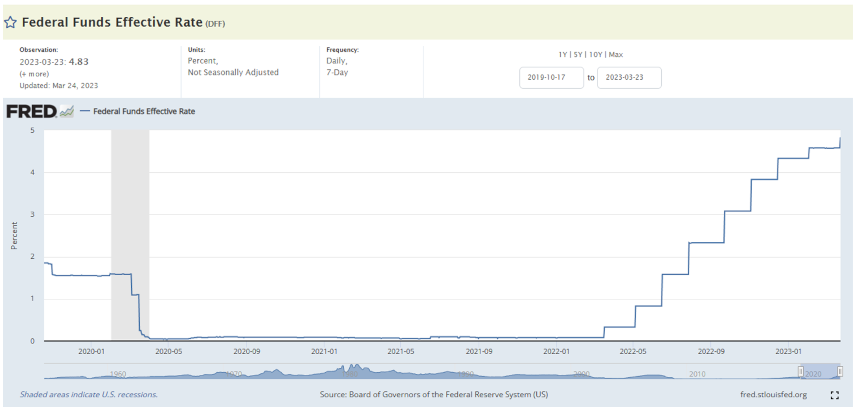
This, in and of itself, would not have done any of these banks had not the run on their firms also coincided with the Fed raising the Federal Funds Effective Rate sharply over the last year from essentially zero to 4%.

The end result was that two of the banks, Silvergate and Silicon Valley Bank, had to generate immediate liquidity by selling their long-term bonds before they matured.  With greater returns available to investors buying new bonds after the rate hike, both Silvergate and Silicon Valley Bank were left holding what were essentially value-less bonds, which they had to sell at a loss rather than hold to maturity.   These losses, in turn, led to both firms with no way to recover with Silvergate voluntarily goinginto liquidation and Silicon Valley Bank being put into receivership.

The cause of the collapse of Signature was rooted in an overexposure to cryptocurrency.  It isn’t clear from the available reports whether Signature was also caught between the cryptocurrency-rock and rising-interest-rate hard place, put even if there were no direct link, there is a case to be made that the very low interest rates during the pandemic meant that any firm investing in anything risky would be vulnerable to rising interest rates.

As of mid-March, the Treasury, the FDIC, and the Federal Reserve had assured depositors that they would be made whole, even if their accounts totaled larger than the $250,000 maximum insured by the FDIC.

Next month’s post will examine whether this ‘make them whole’ approach is reasonable or whether it opens a door for a host of moral hazards.

Adverse Selections and Moral Hazards

One of the most interesting aspects of economics is the study of how various incentives lead to either desired behavior by agents in an economy or to behaviors full of unintended consequences.  Past columns of this blog have dealt with various scenarios in which perverse or incorrect incentives lead or have led to behaviors that are economically undesirable. For example, the promotion of electric vehicles, ostensibly with the idea of preserving the environment, leads to two undesirable outcomes.  First, the cloud of apparent virtue that many owners surround themselves with leads them to be even less aware of the environmental impact that the production of electricity, some of which they use to power their vehicles, has on the environment by way of carbon emissions and other pollutants at coal-fire power plants.  This method of energy production to drive an automobile might likely more damaging than burning gasoline in an internal combustion engine, but the absolute certainty projected by the governmental and media infrastructures persuades consumers that they needn’t even ask the question.  Second, the fact that roads are funded by the tax levied on gasoline sales means that owners of electric vehicles do not pay their fair share in the maintenance and upkeep of the highway and buy way system of the United States which benefits everybody.  The thought that they might be sponging off of the efforts of others doesn’t even enter into their discourse.

Other examples have been covered in various columns (an inventory will be given below) but it became clear, as I listened to a set of lectures on the financial market, that this column had never offered a rigorous or systematic discussion of how economists view undesirable behaviors and outcomes as a whole and it seemed that now was a good time to make such a comparison.

Generally speaking, economists seem to group these kinds of market failures (their term for the rise of bad behaviors and outcomes) into two broad categories known as adverse selection and moral hazard.  Of course, there are many subdivisions possible within each and academics will often disagree with other’s subdivision or set one scenario or another aside as its own category for special consideration, but these two categories seem to provide enough structure to organize the various bad behaviors that perverse incentives can give rise to.  At the heart of their distinctions are the questions of timing, risk, and who bears the cost of the market failure.

Adverse selection occurs when, due to a lack of information (called information asymmetry), the wrong type or class, defined as having characteristics not well suited to the demands of the market, is favored by the incentives of the market.

A classic example, adapted from one Prof. Collen Fullenkamp’s lectures on the financial markets, is the issuance of a loan.  For the sake of this argument, we’ll imagine that borrowers fall into two categories: safe and risky.  A safe borrower takes his commitment to the lender seriously by putting the money he obtains towards his stated purpose and by paying off his loan on time.  In contrast, the risky borrower doesn’t take his loan commitment seriously and is much more likely to default.  If the lender had complete information he could either not issue loans to the risky type or set the interest rate of those loans at a premium to cover the risk.  But, due to asymmetric information, even though the applicant knows his type, the lender doesn’t and he is forced, if he wants to stay in business, to make some number of loans to the risky types.  Suppose that the lender, having analyzed the behaviors of the two types sets the interest rate for safe and risky borrowers at 5% and 20%, respectively.  A naïve lender may then argue to himself that if the borrower where as likely to be safe as risky then a reasonable interest rate would be 12.5%, since this value would return the average interest rate for a group of borrowers without the hassle of trying to discern which type each borrower was.

Any lender trying this approach would quickly find himself in trouble since the safe borrowers, knowing themselves to be worthy of a better rate, would decline to borrow while the risky borrowers, knowing a bargain when they see one, would line up in greater numbers.  The lender, by his naïve approach to the numbers, would have created an incentive favoring the risky borrowers over the safe.

In contrast, a moral hazard is a market failure in which an agent within an economy has an incentive to take on more risk than he ordinarily would because he does not bear the full cost of the risk.

The case with electric cars discussed above as the opening example is one such scenario but perhaps the most-cited example is the holder of an insurance policy who behaves more recklessly than he would without it under the belief that someone else will bear the cost should things go awry.  If rumor is to be believed, this effect is particularly present in car and house rentals and is one of the reasons that a security deposit is demanded before access to both are granted.

The Wikipedia article on adverse selection presents the following table as a comparison between these two effects:

Adverse Selection Moral Hazard
Asymmetric information regarding the: type of an individual the behavior of an individual
Results in a bias: before entering a contract after entering a contract

I have may doubts as to using information asymmetry as the organizing principle.  It seems that the salient point in the case of the moral hazard is that there is a strong temptation for every individual, regardless of his ultimate decision on whether to act on it.  It is more important to eliminate that temptation than to fret over not knowing who will succumb.  Focusing on the temptation-aspect of the moral hazard is not only important because it helps us de-incentivize bad behavior it also serves as a valuable organizing principle for seeing that the free rider and tragedy of the commons problems are aspects of the moral hazard.

Finally, as promised, here is the inventory of past columns that have touched upon one or the other of these effects.

Adverse Selection:

Moral Hazard:

The Good Ship B&N

One of the particular virtues of Moby Dick, extolled by schoolteachers far and wide to those of us old enough to have read Melville’s magnum opus, was that the sailing vessel the Pequod captured the greater world writ small.  The ship was, as the literary phrasing goes, a microcosm in which the various tensions in human society could be studied on a scale more conducive to thoughtful analysis.  While it isn’t clear how truly applicable that notion is versus how English teachers wished it to be there is no denying that often in the world of economics the large scale forces within an economy materialize on a local scale, allowing us to look, at least in a limited way, about their respective pros and cons.  Case in point: the surprising turn around of Barnes & Noble Booksellers.

As Ted Gioia points out in his article for substack entitled What Can We Learn from Barnes & Noble's Surprising Turnaround?, B&N, which has been in business for over 130 years, is not only shrinking due to marginalization by digital vendors like Amazon, it is actually growing.  The chain is planning on opening new stores across the United States as they and other big-box retailers are growing.  The Wall Street Journal notes that:

The bookseller had been contracting for more than a decade as it struggled to compete with … online retailers, and now has about 125 fewer stores than it did at its peak 14 years ago. But this year Barnes & Noble is opening more stores than it is closing, including two Boston-area stores in locations formerly occupied by Amazon Books.

What is especially surprising about this move is that B&N is doing it by embracing the ‘ancient’ technology of the printed word.  To quote Gioia:

All the cool and up-to-date technologies are in financial trouble. Tesla share price has collapsed. Crypto is in decline. Netflix stock has dropped more than 50% in the last year. Facebook is in freefall. Even TikTok might be in trouble.

He goes on to note that, for a while, B&N tried to compete with online retailers, dumping a tremendous amount of effort into the Nook, their ereader.  Sales of the Nook peaked in 2012 and have fallen continuously since then and the companies fortunes seems to head in the same direction.

But recently, the company jettisoned its old upper-management structure and brought in James Daunt as the new CEO.  Daunt had success across the pond in Waterstones book sellers in England and is applying that same philosophy here in the US.  According to Gioia, that philosophy consists of two simple pieces: 1) Daunt loves books and 2) he has moved the decision making as to what books should be carried to the discretion of each store’s manager.  Gioia quotes Daunt as saying:

“Staff are now in control of their own shops,” [Daunt] explained. “Hopefully they’re enjoying their work more. They’re creating something very different in each store."

Central to this staff-controlled approach, is the idea that no longer will B&N take promotional money from the publishers.  Under the old way, publishers only had to cozy up to an upper-management purchaser to set down the featured titles for the entire chain.  The titles were then forced upon each branch whether they liked it or not, whether the title would sell or not.  Under this new approach, publishers no longer had one point-of-sale to B&N’s head buyer at headquarters.  They now had to engage in the hard work of engaging with each local book buyer.  Furthermore they were now accountable if a new book fails to live up to the hype.

This is where the microcosm idea comes in.  In moving control away from B&N upper management to the ‘boots on the ground’ running each store, Daunt has played out a small drama between collectivism and central planning, on one hand, and liberty and individualism on the other.  And the fact that he has turned around B&N by embracing individual control speaks volumes about the power of such ideas.

There are many parallels between this microcosmic experiment and the larger macroscopic approach that was on display in the former Soviet Union.  As Thomas Sowell points out in his book Applied Economics, Thinking Beyond Stage One, the USSR had “[t]he most thorough-going control of entire national economies” but that the task of centrally managing “was a virtually impossible task for the central planners to perform well”.  As a result, Sowell points out that it was common to find warehouses packed with goods nobody wanted while eager consumers lined-up for the few goods that were highly demanded but which had been produced in too few numbers.

Sowell is being charitable when he notes that the job of the central planner is virtually impossible.  That charity presupposes that the central planner wanted to do a good job.  As anyone whose interacted with his state’s department of motor vehicles can attest, there are a class of civil servants who simply phone it in.  They are lazy and strive each day (note the irony of that phrasing) to do as little as possible.  This ‘phone it in’ behavior is strongly reflected in Gioia’s own analysis of the interaction between publisher and central buyer.  Under a decentralized system each of these groups were no longer disengaged from the consequences of their actions and were no longer accountable to virtually no one.

Of course, there are many places where the parallels break down (e.g., it is unlikely that B&N will have nuclear weapons or will mount an invasion into a sovereign country) but those are differences of quantity not quality.  By embracing a ‘bottoms-up’ approach, Daunt is empowering each store to stand or fall on its own by taking into account what the local sector of the economy it serve wants and needs rather than what a central planner decides.  That B&N is experiencing growth underscores the fact that providing value is a much sought-after thing in any economy and is something which central planning, be it peopled by devils or angels, can never achieve.

What's in a Name

What’s in a name?  Some names are long and some short.  Some are descriptive while others are cryptic.  It is often the case that the most famous (or infamous) amongst us are known by nicknames; short hands as it were.  Names such as Einstein, Bluebeard, Cher, Hitler, and Madonna are instantly recognizable without any additional information.  But even nicknames are too long in today’s ‘fast-paced’, digital world and the primary players in this month’s drama have only initials to mark their existence:  SBF and CZ.

For those living under a financial rock, SBF is an abbreviation for Sam Bankman-Fried and CZ for Changpeng Zhao.  SBF, was until recently, the CEO (yab – yet another abbreviation) of the now bankrupt cryptocurrency exchange FTX, at one time the second-largest cryptocurrency exchange in the world.  CZ is the current CEO of the largest cryptocurrency exchange in the world Binance.

The story of the interplay between SBF and CZ, of SBF and his, admittedly, polyamorous girlfriend Carolyn Ellison and the ultimate loss of, at this point, tens of billions of dollars has been ably chronicled many outlets.  The story of the whole sordid details can go on for hours and, indeed, there are many pieces on the FTX collapse and more are being written at an ever-increasing pace.

But only the highlights, taken from perhaps the single best overview by ColdFusion TV, in their short film The FTX Disaster is Deeper Than you Think, matter for this analysis.  In that approximately 30-minute documentary, they assert the following points:

  • SBF graduated from MIT in 2014 and started at Jane Street Capital.
  • While at Jane Street, he discovered an arbitrage opportunity that allowed him to buy Bitcoin in the US that he subsequently sold in Japan. There he also met a Stanford graduate by the name of Caroline Ellison.
  • In 2017, he used the profits he derived to found Alameda Research, a company run by him and his MIT buddies and associates from Jane Street, including Caroline.
  • Alameda promised 15% annualized returns to get customers in the door.
  • In 2019, he created FTX, cryptocurrency derivatives exchange that functioned much like a bank, providing a place for owners to store and exchange cryptocurrencies and tokens for a fee. Clients were offered a discount if they stored their money in a token called FTT, which was made by FTX.
  • The FTX token was essentially money made up by FTX:
    • Cory Klippsten, CEO of Swan Bitcoin was quoted as saying: ““It’s fascinating to see that the majority of the net equity in the Alameda business is actually FTX’s own centrally controlled and printed-out-of-thin-air token.”
    • To quote the documentary: “In essence, Sam created a coin, artificially attributed value to it, and then used it as collateral to finance his projects. It was very, very shady.”
  • Caroline had little experience in finance and lost a lot of money as CEO of Alameda on bad trades and risky bailouts of small crypto firms.
  • SBF used FTX customer dollars, totally about 4 billion, as loans to Alameda to cover the gambles that failed to materialize.
  • SBF would then get ‘knee-deep’ into politics buying political influence as a way to shape US crypto regulatory structures to favor FTX and shut out his competitors.
  • A single tweet from CZ on November 6, 2022 would start a chain reaction that would collapse SBF’s empire.
    • Binance had initially bought a $100 million stake in FTX; a stake that was later repurchased by FTX for $2 billion dollars mostly in the form of FTT
    • CZ didn’t like SBF’s political maneuvering stating “we won’t support people who lobby against other industry players behind their backs” and tweeted that Binance would liquidate all of its FTT; this triggered a general sell-off that revealed the lack of solvency in FTX and Alameda Research
    • Binance then agrees to buy FTX only to back out a few days later when investigations reveal just how
  • FTX would declare bankruptcy, with Alameda and over a 130 additional companies sinking along with it.

With these preliminaries out of the way, the economics analysis can begin.  There seems to be two major morals from this story:  1) the presence of moral hazards typically results in disaster and 2) regulations as barriers to entry have consequences.  Let’s look at each of these in turn.

It is hard to deny that SBF wasn’t awash in moral hazards.  First there was the overall grooming and institutional hubris surrounding MIT, Stanford, and other ‘high-powered’ schools that encourages the students and subsequent graduates to think that they are smarter than everyone else and that the rules are for those lesser people and not them.  Second, FTX was surrounded by celebrities and sycophants who talked up the wiz-kids at Alameda and FTX.  One investment house even cited the fact that SBF was playing the game League of Legends during an investment call.  In addition, many institutional investors were happy to not ask questions about FTX using their own made-up FTT token as collateral.  Finally, there is the connections between SBF and Caroline Ellison (polyamorous lovers), Caroline Ellison and MIT economics professor Glenn Ellison (father-daughter), Glenn Ellison and SEC Head Gary Gensler (boss to former employee – Gensler was an MIT economics professor), and Gary Gensler to SBF (regulator to regulatee).

If the Cold Fusion documentary is to be believed, there are credible allegations that the SEC provided FTX with a conditional no action relief, basically meaning that the SEC knew that something was wrong but chose to do nothing.

Economic historians will have to piece together how much of each of these moral hazards contributed to FTX’s collapse but it is clear that because of them SBF and colleagues to threw caution to the end and embraced more risk than they ought to have.

And these risks may have actually never realized and FTX could conceivably dodged a bullet if it weren’t for the fact that Binance pull the rug from under them.  And the reason for this move was that SBF was currying political favor to lobby for regulations that, on the surface, would keep crypto safe but which, in reality, would have created a nearly unmeetable compliance burden for existing firms and an essentially insurmountable barrier to entry for new ones.

So, there you have it.  At the end of the day, with all the technical terms and digital façade removed, the story of the collapse of FTX and Alameda Research comes down to well-known names for the old-fashioned economic forces of moral hazards and regulatory effects along with a plane, garden-variety embezzlement.  Speaking of names, maybe, going forward, SBF should stand for  Sam Bankman-Fraud.