Uncategorized

On Alligators and Elephants

As one travels through the central core of Pennsylvania, winding one’s way along the Susquehanna River valley one finds many interesting attractions.  One such attraction is the Little League Baseball International Headquarters nestled in South Williamsport, which hosts the international Little League World Series late each summer.  Not more than 10 miles south of Williamsport, overlooking the west branch of the river, is Clyde Peeling’s Reptiland.

Reptiland, featuring many excellent exhibits of poisonous snakes, vibrantly colored poison dart frogs, and ponderous turtles and alligators, is a quaint reptile and amphibian zoo that is fun to visit.  However, it was the gift shop that will really catch the eye of someone interested in economics and incentives.

Set upon on of the shelves is a beautiful box containing the bleached skull of an alligator.


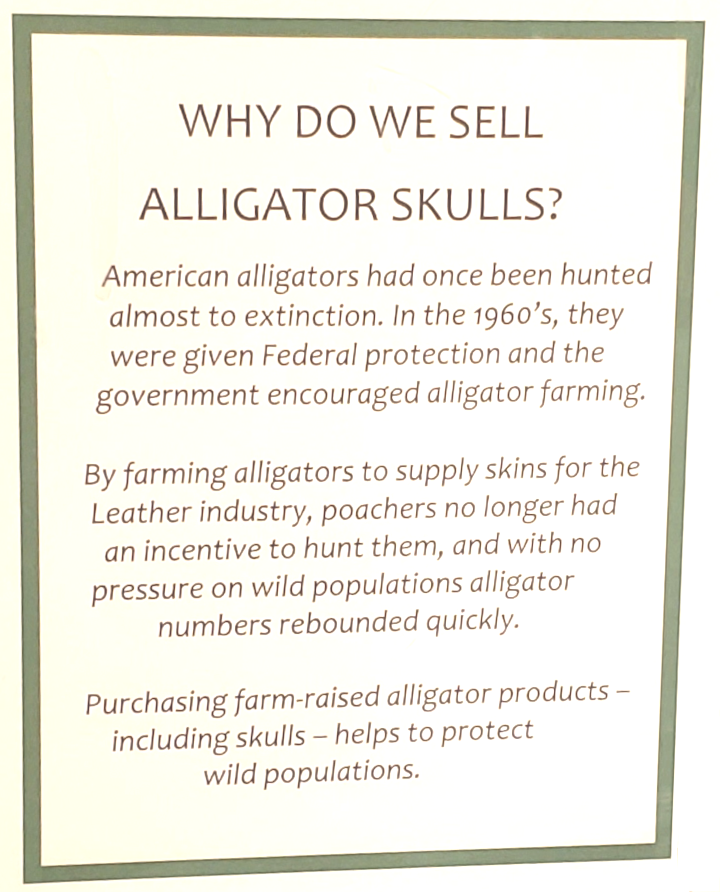
Perched above the box, anticipating possible outrage from the economically ignorant, is a sign that explains why the zoo is seemingly betraying its mission.

The basic message of the sign is simple: that by allowing people to own alligators we, as a society, are best able to protect alligators.  Yes, that ownership comes in the form of farming and farming means that the farmer harvests the animal for parts at the appropriate time.  But, intrinsic to the ownership is also the concept of stewardship.  The farmer has invested time and capital in raising the ‘herd’ since his livelihood is based on the herd’s health.  He will zealously protect that investment in a way that a governmental solution cannot.

Now a careful thinker may object to generalizing this approach to other species.  After all, the second paragraph of the sign from Reptiland’s exhibit, which reads

By farming alligators to supply skins for the [l]eather industry, poachers no longer had an incentive to hunt them, and with no pressure on the wild populations, alligator numbers rebounded quickly.

surely, can’t apply to other endangered species such as elephants that are hunted for the ivory in their tusks.

But the public alternative is what we have now.  The purchase of real ivory is banned, various governments run ranger programs designed to protect the elephant herds, and still the number of elephants destroyed each year is in the tens of thousands.

Many articles on poaching contain the same litany for the prevention of poaching, litanies that sound good on the surface but fail deeper scrutiny.

As a representative example, Kate Good identifies three broad areas for the average citizen to engage in to stop poaching in her article 10 Simple Ways YOU Can Help Stop Wildlife Poaching Today: 1) sign petitions, 2) provide donations, and 3) volunteer.  Although the critiques against them overlap, let’s look at these three in turn by comparing these efforts as applied to the illicit drug trade and arms trafficking, similar types of crime as poaching that Good identifies in her article.

The US has had a vigorous campaign to raise awareness against the use of drugs for decades now with the most recognizable aspects coming in the form of the Just Say No advertising campaign and similar efforts.   Nonetheless, the use of illegal drugs has never gone away and, being generous, the best that can be said about the drug prevention efforts are that they have blunted the number of drug users by a small percentage – a valuable effort perhaps.  The flaw in the thinking is philosophical.  These programs assume that the key to prevention revolves around knowledge; that if the potential user knows drugs are bad then they won’t use them.  But this attitude flies in the face of everything we know about human nature.  Generally, people know what is right and what is wrong (even if they don’t deeply understand all the implications) and choose to do wrong all the time.  The same holds for signing anti-poaching petitions.  Which of the current spate of poachers is suddenly going to be enlightened?

Next, let’s look at providing donations.  Good’s first suggestion is to “[d]onate through the WWF’s Back a Ranger Project to benefit the men and women who put themselves on the front lines against animal poachers.”  Rangers, like police officers, serve an important role in fighting crime but, like conventional police, their primary function is to catch the criminal after the event has taken place.  Rarely can any law enforcement officer prevent the crime from occurring, especially in the case of poaching where the victim is unable to speak or call for help and lives on millions of sparsely populated lands.  The fact that neither laws nor law enforcers form a significant deterrent can be seen from the fact that some countries even punished poaching by death.  If capital punishment doesn’t act as a deterrent to murder which set of new laws is going to make the criminal suddenly decide the risk isn’t worth it?  Donations to other entities is even more ineffectual.  As discussed above on the critique to signing petitions, which criminal is going to have his heart swayed by a touching video or post that comes across his feed?

Good puts volunteering in the final category.  She suggests that the average person can volunteer to help either the indirect efforts (petitioning, messaging, lobbying, etc.) or the direct efforts (patrolling and protecting).  The same critiques leveled for the first two categories apply here.  No government agency will benefit from volunteers in enforcing weapons trafficking and, I suspect, no ranger in Africa or India will benefit from a well-intentioned amateur.

The solution lies in recognizing, as was done for the alligator problem, that poaching is symptom of the tragedy of the commons, as Adam Magoon argues in his article Elephant Poaching: National Tragedy or Tragedy of the Commons?.  The idea is to privatize the ownership of elephant herds in just the way that domestic alligators are farmed.  Let someone get rich from a legal ivory trade in perpetuity.  That someone will ensure that the herd is well cared for and in no danger of going extinct.  That someone will police the lands with vigor and resources unmatched by the government rangers because that someone will have a vested interest in keeping the herd healthy.  Some of the details of how to effect this change can be found in Magoon’s article; others can be found in the general economics literature.  But the first step comes from recognizing that when government (i.e., all of us) owns a thing, nobody owns that thing and that thing is, therefore, poised for destruction by the tragedy of the commons.

Paper or Plastic

A perennial gag for much of the history of movies is the down-on-his-luck character symbolically reaching rock bottom when the bottom falls out – literally – from a bag or box he is carrying.  A typical scene, common to dramas and comedies alike, centers on our hapless hero attempting to complete one of the most mundane of day-to-day activities, namely buying groceries, with no success.  For one reason or another, be it weight or wetness, when he attempts to lift the grocery bag, typically full of can goods and fruit, the bottom of the bag loses whatever semblances of solidity it had and every item plummets to the ground as he watches on with surprise.  The actor then hangs his head in resigned defeat or rolls his eyes in disbelief and we relate.  Of course, this household disaster writ small only works with paper bags and so the movie most likely was produced before the mid-1980s.  After that time, as some may say, America began its “dangerous obsession” with plastic bags – an obsession that may be coming to an end as more and more people return to the “natural goodness” of paper bags after they “realize” just how bad these “little petroleum pieces-of-hell” actually are.  As we explore this pendulum shift from paper to plastic and now heading back to paper, we will find a bigger lesson on economics and rational thinking.

In his engaging article History of Plastic Bags: How Did We Get Here, author David Evans walks through the timeline whereby the paper bag was supplanted by the single-use plastic bag, hereafter usually referred to as simply the plastic bag.  The plastic bag comes from humble roots beginning with the invention of polyethylene in 1933.  While this chemical concoction was intriguing, it lacked the necessary strength to become a household fixture.  A couple of decades later, high-density polyethylene (HDPE to those in the know) is invented and, to quote Evans, “HDPE gives plastics the strength they need to be light, moldable, and still strong.”  In 1965, Karl Ziegler was awarded the Noble prize in chemistry for his invention of HDPE.  That same year, the plastic grocery bag was invented by the Swedish company Celloplast.  A scant two years later, the famous ‘plastics’ scene from The Graduate was released for general consumption and a polymer-plague was unleashed on mankind.


With plastic fever gripping the country, somewhere, somehow, around the late 1970s or the early 1980s, we collectively decided that plastic bags were the way to go.  As I remember it, we argued that paper bags presented a clear and existential threat to everyone everywhere, that we wanted to save the forests, and that we could protect the environment by using products that came from organic materials made from living organisms long since expired.  Of course, behind the scenes, there were undoubtedly rational cost-benefit analyses being performed that showed corporations the saving that plastic bags promised given that they are generally lighter than paper bags.  Assuredly, there was also lobbying being done by the plastics industry more vigorously than the paper industry.  But none of this made it through to the average Joe.  The slickest devices of Madison Avenue packaged the changed, which Evans describes as a “transition [that] was out of the hands of the consumer, from paper to plastic as friendly to both Mother Nature and our wallets.  Deep down, I still suspect that all those movie gags had a powerful effect on our subconscious and we all bought whatever excuse spared us from being the butt of the joke.

Regardless of exactly how all these reasons blended, in 1982 Safeway and Kroger supermarket chains made the transition and plastic bags became a common sight in the checkout lane.  For a while, most of us were given the choice: “paper or plastic”.  But, eventually, even this choice went away.  Only a few iconoclastic brands, such as Trader Joes, continued to use paper bags.  As the number of people grew and the number of goods being purchase skyrocketed, it started to become clear to even the densest amongst us, that plastic bags did have a downside, beyond the fact that they are stubbornly difficult to open.  Because they couldn’t biodegrade, a plastic bag that went rogue and escaped its owner’s grasp would eternally drift around streets and highways like some demented will-o-the-wisp, blowing this way or that as the wind gusted or traffic passed by.  Clean up costs mounted and, despite the efforts that were made to recycle them, only a small fraction of the available bags ended up in other products; the bulk ended up in landfills.  And so, with growing alarm, society is now turning its back on single-use plastic bags and again re-embracing the humble brown paper bag.  New York state has already take steps to ban single use plastic bags in many venues (see e.g., New York State to ban plastic bags—here's why).

Now there is nothing wrong with changing course and learning from our mistakes.  But there is a huge difference between rationally responding to challenges and emotionally responding to propaganda.  Apparently, those environmentalists of the 1970s and 80s who advocated the need to eliminate paper bags never looked at the fact that trees grow naturally; that people can cultivate and grow trees for the express purpose of being harvested for lumber and paper; and that the vast majority of the energy to grow and mature new trees is freely given to us by the Sun.  By the same train of thought, if one is being honest, are the advocates pushing for a migration back to paper now really looking at the whole, interconnected system or are they merely looking at the problem in front of their collective face?  The bane of economic decision making is focusing on the problem that is apparent at the cost of neglecting the unseen problems that will follow in the wake of a poor decision.

Of course, only time will tell if this current spate of drama-driven decision-making approaches rationality or whether forty years from now we’ll be lamenting the demise of the plastic bag.  Sadly, it seems certain, regardless of whether everything “turns out alright” or “turns out to be a disaster”, that most of us won’t get any more economic wisdom because the bottom of thinking has dropped out.

Student Loan Hazards

Student loan forgiveness is a trendy topic these days. We will ignore questions about the politics with a capital 'P' that always come up in our hyperpartisan, democrat-vs-republican society as to whether or not this is meant by the current Administration as an attempt to Curry votes. Instead we will focus on the economic considerations (politics with the lowercase 'p') and the resulting behaviors, incentives, and moral hazards that result.

Speaking with some friends recently, the question came up as to whether COVID business loan forgiveness and student loan forgiveness are not each moral hazards and isn't hypocritical, as some are now doing, to condemn the former while condoning if not downright praising the latter. For those who need a refresher, a moral hazard is a term used by economists to describe how a societally undesirable behavior can result when an incentive is in place that shifts the risk or cost of the behavior from the agent performing the behavior to someone else.

It may seem odd that the term moral hazard can even attach to something as seemingly benign as loan forgiveness. After all, shouldn't we be sympathetic to the plight of people who are crushed under the weight of predatory loans? Or, maybe, the right way to express that question is to ask why we should we play favorites to careless fools who got their instant gratification by stupidly entering into a loan that they cannot afford. Neither of these foregoing questions really matter because, as is obvious, the framing of the question in both word choice and ethical viewpoint changes the way one answers the question. The better way to look at these questions is from the perspective of behavioral economics - how do the incentives built into the system drive the resulting behaviors and are these behaviors something we want.

Both types of loans, COVID business relief and student debt, fall outside the usual structure of a traditional loan in that neither required collateral to secure. But that is where the similarity ends.

The small businesses that received COVID-relief loans were profitable pre-pandemic. To be in business, each of them did everything society at asked; they went through all the necessary licensing compliance steps, they offered a good or service that people wanted, and they stayed on the right side of the law (at least overtly). Their need for a loan was due to society not keeping its part of the social contract when it decided that these businesses needed to be closed for the good of everyone in the face of the virus. None of these businesses engaged in risky behavior that led to the need for a loan but rather each was acting as good citizens when they agreed to forego their livelihood to comply with a situation that they neither caused nor directly contributed to. Any of the loans a business received during the shutdown resulted in no moral hazard since these loans were not incentivizing the behavior that led to the shutdown and, so, the corresponding loan forgiveness doesn't reward risky behavior society would explicitly want to avoid.

On the other hand, there was no compliance burden with which a prospective college student must comply; no gates that society made them go through before they were allowed to borrow. Nor were students required to receive a loan only for those degrees that were immediate useful to the broad public or in high demand. Instead, students pursuing any discipline were granted access to a virtually limitless budget for immediate transfer to an institution of higher learning. The only tangible restriction was that students taking out these loans were required to pay them back - no ability to get a clean slate even by declaring bankruptcy. This approach has led to a variety of moral hazards.
Student-held debt now outstrips consumer-held debt often in support of academic degrees that place students in a worse rather than better earning position. Larger and larger segments of students are defaulting on loan payments leaving lenders with continually shrinking returns on investment. Employers are citing students as being increasingly less-well prepared for real-world employment necessitating more training investment before an employee becomes productive.

One school of thought blames students and their families for misusing a valuable resource. Their argument is that parents should know better than to allow their 18-year old child to pursue a degree in medieval French poetry without realistically assessing the likelihood of making a viable living pursuing his passion. These critics also point out the folly of parents buying into the idea that the only way their children can earn 'good money' is with an advanced degree. Another school of thought points out that colleges oversell the benefits of the campus experience by providing an ever-increasing set of amenities while downplaying the financial obligation each student assumes. As evidence they offer they fact that the rate of tuition growth has outstripped inflation by a factor of 2 or 3 over the past 30-40 years resulting in the 'big education bubble', which is very reminiscent of the big housing bubble of 2008 except for the fact that it hasn't yet popped.

Regardless of which of the above arguments one finds persuasive, the student loan program, by incentivizing risky behavior, is the poster child of moral hazards. Forgiving this student debt only compounds these problems by now eliminating the only possible good that could have resulted, namely that the crushing debt held by graduates and the misery that follows in its wake would finally force newer parents and students to reevaluate the value of a college degree. By forgiving student debt, the government has shifted the risk from students and colleges to workers who either have paid off their student debt or, worse still, never had student debt in the first place.

So, it is crystal clear that there is a fundamental difference between COVID-relief loan forgiveness and student-debt forgiveness in that the former simply constitutes a helping-hand for people who founds themselves victims of circumstances that they had nothing to do with while the latter is an encouragement for behavior that poses a clear and present moral hazard.

The Joshua Bell Experiment

In 2007, classical violinist Joshua Bell went incognito to play an impromptu concert in L’Enfant Plaza just outside a Washington Metro station.

Much has been made of the fact that ‘no one stopped to listen to him play’ and ‘only a handful’ even so much as paused to regard his renditions of pieces by Bach, Massenet, Schubert and others.  Wasn’t this the same world-renowned classical music composed by the greatest of classical composers?  Wasn’t this violin one of the most expensive musical instruments ever made? Wasn’t the performer one of the world’s greatest musicians who people line up to hear, often paying hundreds of dollars for the privilege?  How could the public response be so cold and indifferent?

Before digging into those questions, let’s take a moment to clear up a few misconceptions identified by Gene Weingarten, the Washington Post reporter who setup this ‘experiment’ and who garnered a Pulitzer Prize for his efforts.  First, the ‘popular’ account that many people have heard is likely apocryphal as Gene makes clear in his article Gene Weingarten: Setting the record straight on the Joshua Bell experiment.  Several people did stop and listen.  Second, and more important, the ‘stunt’, as Gene has called it, has exacted a toll on Joshua Bell in a way that neither of them anticipated.  Being ignored was disconcerting (no pun intended) for the classical violinist, so much so that Weingarten describes Bell as being nervous prior to a repeat engagement.  Happily, Bell’s second go in 2014, which was properly billed and announced, went far better.

Nonetheless, the essential aspect of the story was correct – a thing (musical performance by Bell) is highly sought after in one context and highly ignored in another.  This post is not intended to heap any additional discomfort on Bell nor is it to meant to criticize society as a whole and lament as to what is wrong.  It is merely meant to look at ways of explaining that contextual difference.

YouTuber Conor Neill offered an Aristotelian explanation for the contextual difference.

While I am a big fan of Aristotle and I don’t discount the psychology (the failure to connect with the pathos and ethos of the ‘audience’) that Neill explores, I think that he misses the point.  And, while I am religious, I think all the sermons delivered by priests, preachers, and pundits on this experiment also miss the point.  As do any other analyses that try to understand why and draw conclusions.  It isn’t important to determine whether one person passed by because he was late for work, while another failed to linger because, as a Metro passenger, he connects more with Rock music, and that a third only would have listened had he known that the musician was famous.  These particulars are just that – particular reasons that each person had.

Rather, the real lesson here is one of economics.  Regardless of why these 1097 people basically ignored Bell’s performance in L’Enfant plaza they did ignore it.  Clearly the performance did not have value to them.  Much like those famous cautionary tales about gold being useless to a man dying of thirst in the desert the only lesson here is that value is in the eye of the beholder – that there is no true and objective worth that any of us can put on anything.  It is this subjectivity that makes it possible for us to deal with each other in the economic sphere and come away after this interaction better off than when we started.

Sri Lankan Meltdown

If you are like me, you may actually be too busy working on your own personal economy to pay attention as entire countries blowup their own.  Why any country would contemplate destroying its own livelihood let own along carry it out is hard to grasp nonetheless it happens.  One explanation is that leaders, with far too much emotion and far too little understanding of basic facts, apparently decide to embrace an ideology at the expense of an economy. You, dear reader, can, no doubt, construct other underlying explanations (e.g. corruption) but the root cause of the decisions are not nearly as interesting as the decisions themselves. It is far more instructive to examine the economic impact of a particular policy than it is to understand why such a policy was pursued in the first place.

Case in point:  Sri Lanka.

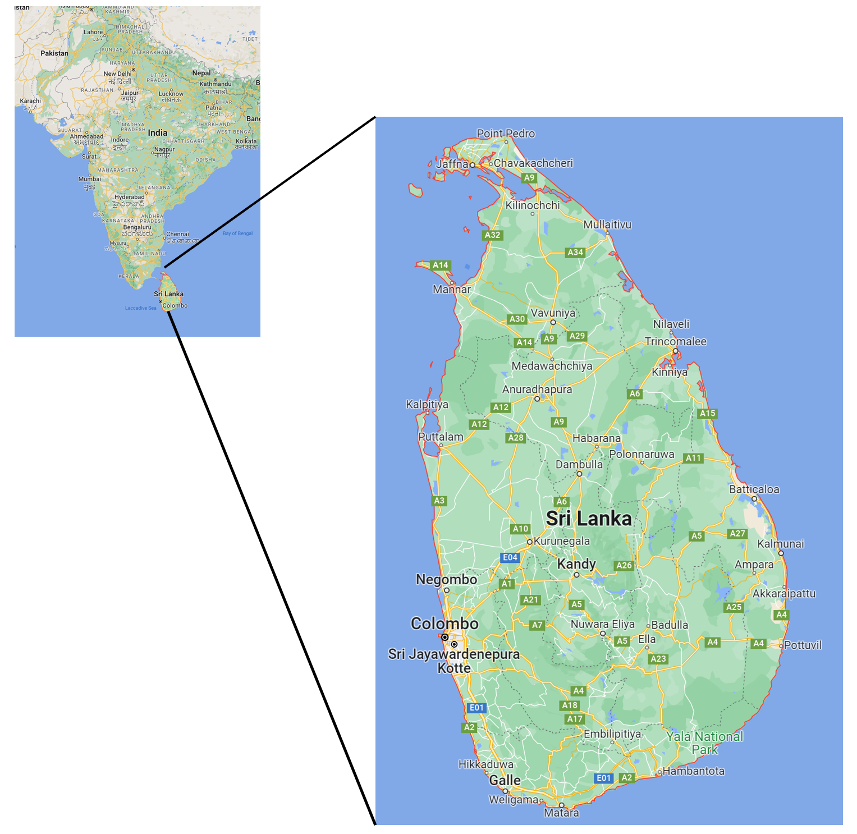
Sri Lanka is an island nation tucked off of the south-east corner of southern India (individual map source: Google Maps).

The CIA Factbook on Sri Lanka lists it as home to approximately 23 million souls of mixed cultural descent (Sinhalese 74.9%, Sri Lankan Tamil 11.2%, Sri Lankan Moors 9.2%, Indian Tamil 4.2%, other 0.5%) with most of the original inhabitants believed to be from India.  The island was controlled by the Portuguese and the Dutch in the 16th and 17th centuries, respectively, before being ceded to the British in 1796.  It remained under British control for 152 years before gaining its independence, as the dominion of Ceylon, in 1948.  The nation changed its name to The Democratic Socialist Repulic of Sri Lanka (or simply Sri Lanka) in 1972 when it transitioned from an independent country associated with Great Britain to a solely sovereign country.  It has been mired in sectarian violence and civil war between the Sinhalese majority and Tamil separatists, to varying degrees, from this inception until the decisive victory of the government over the Liberation Tigers of Tamil Eelam (LTTE) in 2009.

Because of it location in the Indian Ocean, the island offers strategic value for maritime trade, which explains why it was highly sought after and contested for by the European powers in the 1600s and 1700s.  Sadly, the promise of its location has not translated into prosperity.  The problems with the economy are described, on the more diplomatic side in the NBC News article What is happening in Sri Lanka?, by Rhoda Kwan and Meredith Chen, as the worst economic situation the country has had to endure since it gained its independence from Great Britain.  Other articles are more blunt and describe Sri Lanka’s economy using in the words of Sri Lanka’s latest Prime Minister Ranil Wickremesinghe as having collapsed.

So, just what went wrong?

There is no shortage of conjectures as to the root cause and explanations range from exploding foreign debt, to the dearth of tourism caused by COVID, to ill-advised tax cuts, to rising inflation, to out-of-control government spending, to collapsing currency, to political corruption and mismanagement.  The article EXPLAINER: Why Sri Lanka's economy collapsed and what's next, by Krishan Francis and Elaine Kurtenbach of AP News, explores most of these points in greater depth.

Each of these factors have no doubt contributed to Sri Lanka’s economic crisis as either a root cause or an intermediate one but an compelling narrative suggests that the national economy had enough resilience to withstand the issues listed above and, instead, points to one key decision that served to bring down the whole house of cards.  The critical decision was made by President Gotabaya Rajapaksa (part of the Rajapaksa governmental clan) in April of 2021 when he banned chemical fertilizer and forced Sri Lanka farmers to use organic methods.  This policy had an almost immediate and disastrous effect or, as journalists Talal Rafi and Brian Wong put it in their article The Deep Roots of Sri Lanka’s Economic Crisis for the Diplomat:

…the decision of the government to ban chemical fertilizers and shift to organic farming overnight led to a 50 percent drop in agricultural output. This adversely affected the tea industry hard, which had been another major source of foreign exchange.

Micaela Burrow, whose article ‘Complete Collapse’: Here’s How ESG Destroyed One Nation’s Economy appeared in the Daily Caller, agrees with this conclusion.  Burrow quotes Peter Earle, described in the article as a economist at the American Institute for Economic Research as saying:

[t]he decision to overnight shift away from synthetic fertilizers was an absolute disaster

Burrow goes on to lay the roots of this decision with the government's aim to align with the ESG (environmental, social, and governance) movement stating that:

[e]nvironment Minister Mahinda Amaweera declared a government initiative to save the earth from “our own geoengineering misuse, greed and selfishness” in 2020 ahead of a forum on halving nitrogen waste. The move was part of Sri Lanka’s effort to pursue environmental, social and governance (ESG) goals; the country signed onto a green finance taxonomy with the International Finance Corporation in May that included a commitment to organic fertilizers.

I find this argument compelling for two reasons.  First, by most economic measures, in 2019, Sri Lanka had a growing and thriving economy that was in some ways on par with if not in front of the US.  Even though the GDP of the island country was over 300 times smaller than that of the US, Sri Lanka’s per capita GDP to external debt was comparable (1.58 for Sri Lanka v. 1.25 for the US) or, correspondingly, its debt to GDP was 66.7% v. 81.9% for the US.  The growth rate of the two countries was also about the same at around 2% (most statistics obtained from MacroTrends with the exception of US debt which came from Peter G. Peterson Foundation).  Based on these data there was no reason to believe that Sri Lanka would not have weathered the storm cause by COVID just as the US has; no reason except an incredibly stupid decision that, even if firmly believed to be based on a sound principle, should have been deferred until the world had again normalized.

The second reason is psychological in nature.  Leaders in almost every form of government rarely feel the pain they inflict on everyone else and so they make easy prey to peer pressure and virtue-signaling lobbying.  Being charitable, I suppose that is was the desire to be thought of as sophisticated and worldly that led the Sri Lankan leaders to embrace a radical change in their economy just when so many other changes had already been forced on them due to COVID.  I guess the famous sentiment of the character Mona Lisa Vito (played wonderfully by Marisa Tomei in My Cousin Vinny)

never occurred to them.

Money and Inflation

By all measures, June is the ‘summer’ month.  By popular rendering, June is the first month of summer following hard on the heels of the common entry into that season with the passing of Memorial Day.  By official rendering, June is also the official, astronomical start of the summer given that it contains the summer solstice when the day is as long as long can be.  And, by all measures, Americans are going to be paying more for their summer fun especially if that fun centers around food or driving anywhere or doing anything.  About the only thing that is cheap right now is talk so we’ll expend some of that tracing the roots of the current price hikes we all see.

System inflation was already rearing its ugly head back in September 2021 and at that time this column discussed the very real possibility that what was labeled as ‘transitory’ might be here for some time in post entitled Stagflation and the Phillips Curve.  Sadly, here it is nearly a year later and inflation has nestled into the American economic land scape for the long haul.  The question is why?

Contrary to some popular opinions, the core answer is not to be found in gasoline prices – they are merely a symptom.  Localized shortages, likes those experienced with the Colonial Pipeline shutdown, can drive prices up for a period of time but they can’t effect every sector in the economy.  But we don’t have shortages of gasoline, we have a systemic rise in the price of gas nationwide that is not due to ‘the rapacious greed’ of oil companies.  And, given that the price of gasoline figures into the cost of most everything else, higher transportation costs do get passed onto the consumer and so rising gas prices do have a compounding effect, even if they are not the root cause.

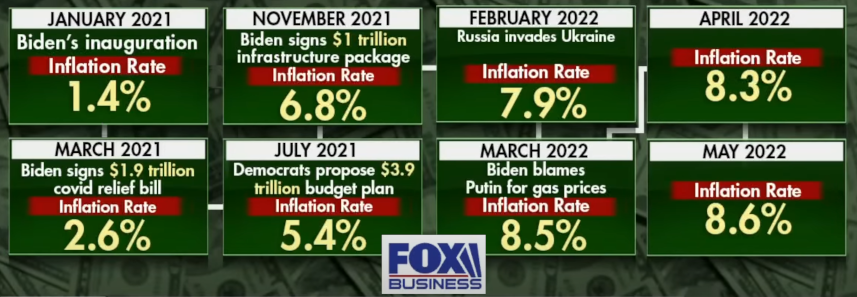
The other popular answer that inflation is a direct result of government spending hits closer to the mark but doesn’t quite get there either.  Fox Business showed a graphic very similar to the one shown below marking the steps of inflation over the last 15 months in attempt to indict the Biden administration’s ‘reckless spending’ as the culprit of high inflation.

The graphic is compelling (even though the box layout and connecting lines are bit confusing) but spending, in and of itself, cannot be the source of economy-wide inflation.

Excellent examples of counter-arguments are found each and every Christmas when some fad takes root and the latest ‘hot toy’ emerges.  To be concrete, no one could have foreseen the intense demand that the Nintendo Wii would command when it came out during the fall of 2006.  Each Wii became such a hot commodity that stores sold out and large resell market developed.  People who had the financial wherewithal to spend small fortunes threw cash around, thereby driving the price up in advance of Christmas day.  And yet, the economy as a whole didn’t suffer inflation.  Other, more modern, examples of ‘runaway prices’ include the Game Stop stock bump and the Dr. Seuss scare where prices of those commodities rose sharply but, nonetheless, did not trigger economy-wide inflation.

With that in hand, let’s return to the Fox Business argument and unpack it a bit.  If the graphic they provided seems to prove that government spending if the culprit but, as was just argued, spending itself can’t be to blame, how can we square these two different points?  The reconciliation lies in not what amount government spent or in what sectors of the economy that spending occurred but rather in how government acquired the money it spent.

When a given individual, household, or firm spends it either takes from its savings or it borrows from someone else’s in order to pay for what it wants or needs.  Government has a third option: it can simply print more money.  In exercising this third option, government typically triggers systemic, economy-wide inflation.  The following excerpt from a talk given Milton Friedman drives this point home.

During the course of the 15 months covered by the graphic above, the Federal Reserve expanded the money supply from approximately $15.5 trillion to $21.6 trillion, an increase of just about 40%.  In the article entitled, Inflation has Fed critics pointing to spike in money supply, author David J. Lynch does a nice job in making Friedman’s case that inflation is monetary in origin.

Friedman, a Nobel Prize recipient, taught that “inflation is always and everywhere a monetary phenomenon,” and said central bankers should prevent the supply of money from growing faster than economic output.

To be fair, Lynch also covers the counter-argument that the Fed is currently mounting by noting that:

But a big chunk of that new money wasn’t spent. Instead, the financial institutions that the Fed paid for those bonds parked more than $2 trillion in their accounts at the central bank while American households banked much of their stimulus checks and now sit on an estimated $2.7 trillion in savings.

That’s one reason that the Fed’s money creation isn’t driving inflation, according to many economists. Yes, there is a great deal more money stored in various forms. But it is moving through the economy more slowly than at almost any time in 65 years.

But this ‘velocity-of-money’ justification for severing the link between money supply and inflation seems hard to reconcile with the Fed now pushing to raise the prime rate.  Making money harder to borrow will result in an even lower velocity.  In addition, according to the article Small US Companies Lose Almost 300,000 Jobs Since February by Alex Tansi of yahoo!finance, there is likely a significant cost to small business growth with this approach:

Firms with fewer than 50 employees have lost almost 300,000 jobs since February. … Some 91,000 of the losses came in May. a possible side effect of rising costs to borrow…

So why not just contract the money supply?  There are several reasons.  First and the most important one is that such a course of action almost invariably triggers a recession.  Second, it isn’t at all clear that all types of money are equal.  Cash stuffed under the mattress is technically in the supply but is doing nothing to stimulate economic activity.  So, how much should the Fed cut and where?  These questions make it hard to find a precise procedure for taming inflation but it seems clear that statements like the one Lynch cites  from Fed Chair Jerome H. Powell that assert that

…the once-strong link between the money supply and inflation “ended about 40 years ago.” Financial deregulation and innovations such as interest-bearing checking accounts and mutual funds meant that traditional measures of the money supply no longer provide reliable signals of future price trends.

should be taken with a large grain of salt.  These statements sound a lot like the expert assertions from the early 2000s that said we were in a new economy in years leading up to the Great Recession of 2008.

Sadly, this is where the story stops.  It looks like we’re going to have to live with inflation for the foreseeable future and it looks like the ‘economists in the know’ are anything but knowledgeable.  My own money is on the monetary-supply theory precisely because it following Occam’s razor and it jibes with what we know are fundamental features of the economy.

Baby Formula Blues

It’s hard to believe that the United States, once not only able to feed itself (and perhaps overfeed itself) but also a large fraction of the world in addition, is now facing a shortage of baby formula.  This shortage does not necessarily mean that the ‘land of the free and the home of the brave’ is in decline but is more an indictment of the kind of short-sighted thinking so common in economically illiterate folk.  But first let’s begin with the facts.

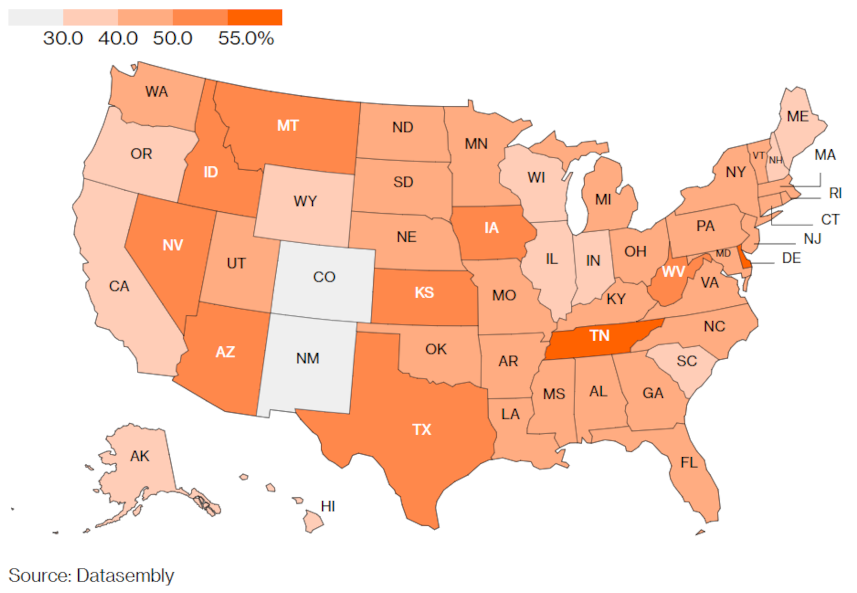
According to the Washington Examiner article entitled Here's what's causing the baby formula shortage, the countrywide shortage, which started in late winter of 2021, regionally ranges from 30% to 50% at mid-May (likely has increased since then).

(Map source:  Infant Formula Shortage in US: Where Is Baby Food Hardest to Find?, Bloomberg)

The article provides a quantitative example of how changes in demand (or quantity demanded) has pushed the cost up by noting that a 12.4-ounce can Enfamil Gentlease, formula design for fussy or crying babies, is listed (at the time of the writing) on eBay for $55 ($45 + $10 shipping) compared to the normal grocery-store price of $19.

Several articles identify the groups hardest hit by the shortage.  The Washington Examiner piece notes that the shortage is “especially acute for parents of babies who require specialty formulas to address allergies, as well as gastrointestinal or metabolic conditions”, while the Everything You Need to Know About the Baby Formula Shortage, by Yahoo, states that “not surprisingly, the most affected parents are those on the lowest income…poorer women, infants and children, [who are on] WIC, which provides formula for a majority of [the] babies in low-income families.”  As a result of how the most vulnerable are being effected, most large retailers are rationing the supply to prevent hoarding.  For example, Target has been limiting purchases to 4 cans while the Walgreens and CVS limits are 3.

Okay, so the shortage is real and painful.  But then why is it happening.

The Washington Examiner article lists four reasons for the shortage:

  1. weak production market unprepared for pandemic hoarding
  2. decline in breastfeeding
  3. recent supply chain problems
  4. Abbott labs formula recall

Let’s look at what the experts have to say on each of these fronts and judge and critique.

Weak Production Market Unprepared for Pandemic Hoarding: unlikely

The pandemic ‘officially’ began in mid-spring of 2020 with the ‘flatten the curve’ edicts coming out in April of that year.  Disposable goods, like toilet paper, were certainly in short supply initially and some segments of the public reacted by buying (i.e., hoarding) immense amounts.  But by the fall of the 2020, manufacturers began to respond – after all their job is to make and sell products in order to make a profit – and the amounts of all goods returned to near-pre-pandemic levels.  The Washington Examiner article even cites (in the discussion of another possible reason) “The supply of formula was relatively stable in the first half of 2021, but by July, the availability of formula on shelves began to dip, according to Datasembly.” So while it is certainly the case that there is some hoarding happening now, it is unlikely that it is anything other than a public reaction to the recent-developing shortage that can be blamed on the pandemic.

Decline in Breastfeeding: unlikely

There are two facts (noted above) that speak against this possibility.  First, the change in a family attitude to a pregnancy or a recent birth is not something that ‘changes on a dime’.  A time scale of years not months is what is needed to see large swings in demographic trends like the percentage of mothers who want to breastfeed.  Second, as discussed above, the supply of baby formula was described as “relatively stable” in the first half of 2021.  The only way that a decline in breastfeeding could have happened so quickly would have been a scenario like the following: suppose the CDC had said that breast milk was now poisonous due to COVID and breastfeeding was ‘contraindicated’.  Under this, admittedly ridiculous claim, one could see large segments of breastfeeding mothers abandoning their regimen and starting a run on the stores.  But there a scenario like this would have been public knowledge and mentioned in the article.

Recent Supply Chain Problems: possibly but small impact

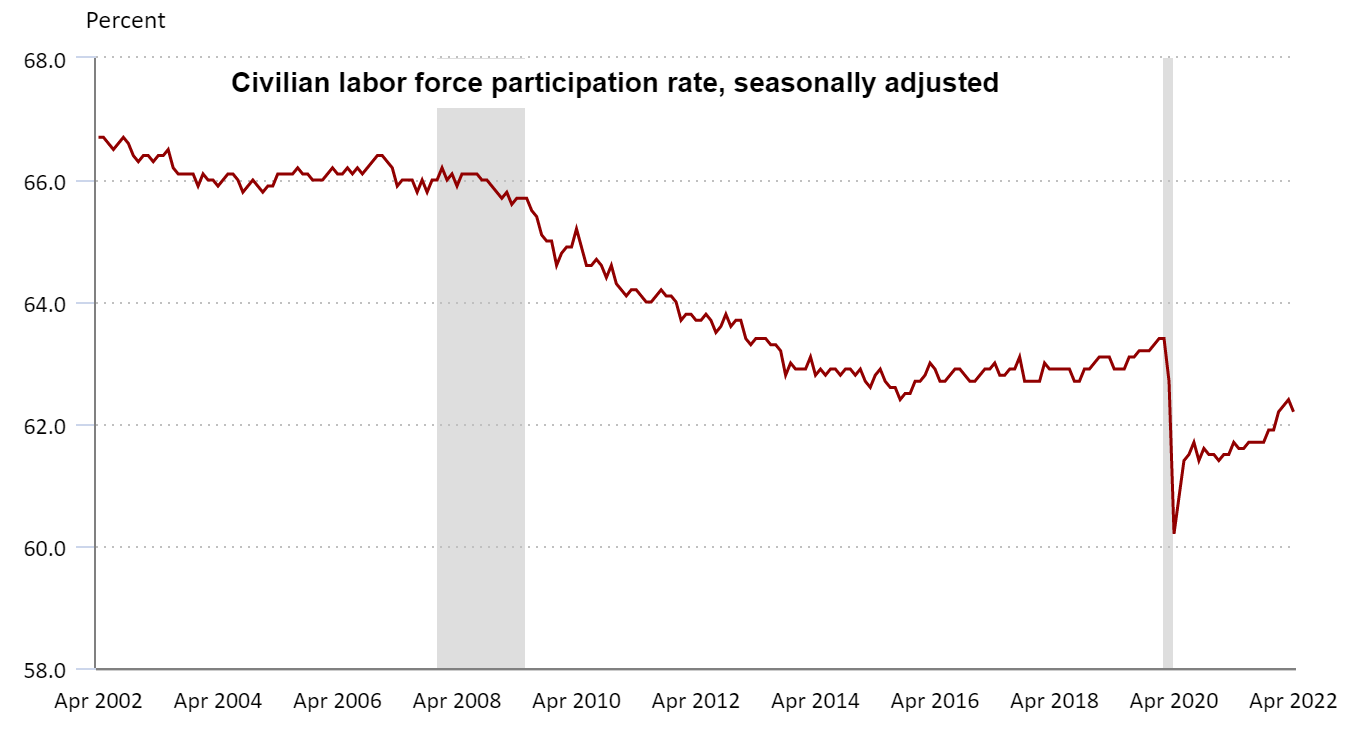
Until recently, the term ‘supply chain’ was known only to a few insiders who cared about manufacturing and production.  It is now a buzz phrase akin to the ‘devil made me do it’.  Nonetheless, there are some plausible and implausible reasons being laid at the feet of supply-chain woes.  In the Washington Examiner article they do list a plausible scenario involving worker unavailability.  Here we find the first of the four governmental failing that help explain the shortage.  The government has incentivized workers leaving the workforce due to COVID by subsidizing people staying home.  The workforce participation rate (graph from BLS) has yet to reach pre-pandemic levels

The article also seeks to blame the war in Ukraine for having a role in hampering imports but this is a unlikely effect as the regulations for importing baby formula are quite restrictive (more on this in a bit).  So, overall, supply chain issues are likely having a small effect on the delivery of more baby formula.

Abbott labs formula recall: root cause

Here we finally get to the root cause of the formula shortage and we will find ample evidence to lay three very big failings at the feet of government.  The single biggest and by far the clearest cause of the baby formula shortage is the FDA’s continued shutdown of the Abbott Nutrition’s manufacturing plant in Sturgis, Michigan.  The FDA stopped production in February after receiving complaints of infections due to Cronobacter sakazakii bacteria and possibly Salmonella, in four babies from September 2021 to January 2022, according to the Washington Examiner article.   According to the article The baby formula shortage is getting worse, by CNN, a former employee filed a whistleblower complaint documenting his concerns for safety problems at the plant. According to the article:

Abbott said the former employee was fired because of "serious violations of Abbott's food safety policies," and that … [a]fter dismissal, the former employee, … has made evolving, new and escalating allegations to multiple authorities

The Abbott spokesperson also said that products tested for Cronobacter sakazakii and Salmonella all came back negative, and that no Salmonella was found at the Sturgis facility during the investigation.

The article entitled Abbott says two months for baby formula to hit shelves amid US shortage, by US News and the Guardian, added that: “In all four cases [of baby illness and death], the state, the FDA and/or CDC tested samples of the Abbott formula that was used by the child,” it said. “In all four cases, all unopened containers tested negative.”

Nonetheless, the plant remains shutdown leaving parents to scramble for ways to feed their babies.

The next governmental misstep was the lack of awareness of the repercussions of shutting off a major supply of formula and failing to be nimble in adjusting the infrastructure by relaxing the restrictions against importing baby formula from overseas.  Clearly, children in other countries grow up to be healthy and relatively happy and yet these governments (often ones being offered as paragons in other settings) aren’t trusted to supply oversight in producing baby food.

The fourth governmental misstep is perhaps to most startling: telling parents of newborns not to create their own home-made formula as it is dangerous.  Really?  Is starvation less dangerous?  Just what do the bureaucrats want parents to do?  Should they hunt around from store to store in the hopes of finding the ‘golden can’ of formula, all the while wasting precious resources on what is likely a fools errand?

The Unseen Cost the Underlying Cause

The underlying cause of these four failings on the part of government is the very problem that Frédéric Bastiat decried in many of his famous discourses on the ‘unseen cost’. The agents of government can clearly feel the ire they would draw if they didn’t provide subsidies for workers sidelined by the pandemic but they can’t see that an over-indulgent application incentivizes lower work force participation.  They can see the accusations that would be hurled towards them if a few ‘infected’ cans of domestically-produced or a few containers of ‘sub-standard’ foreign-produced formula end up in circulation but they feel no heat in turning off the supply.  They rest easy in knowing they did their due diligence in telling parents that there is no home-made substitute for breast milk or ‘approved’ formulas and no single thought of starving babies affect their sleep.

Of course, the bureaucrats are not really to blame.  The system incentivizes them to act this way and they respond.  They give us the regulatory structure we want.  The fault dear reader lies not in them but in ourselves for being willing to cut off our ‘economic nose’ to spite our ‘economic face’.  The only way to fix this wretched state of affairs is to continuous remind ourselves that there is never an entirely correct choice in economics.  Since scarcity is involved in every aspect, every choice involves a trade-off.

When Larry Met Sally

Scarcity.  The very term conjures up images of long lines of people hoping to get food from empty shelves in the old Soviet Union or the proverbial barren landscape devoid of growth and warmth that features just as often in romantic poems from a hundred years ago as in the dystopian motion pictures of modern times.  But we while we should continue to enjoy the melodramatic images of such works of art as T.S. Eliot’s the Wasteland or Suzanne Collins' the Hunger Games, the word scarcity should actually summon mundane images of our day-to-day lives since each of us lives with scarcity simply because we can't get everything we want.  And for such humdrum settings such as one's ordinary life being a vehicle to convey economic (or any kind of) wisdom, no better medium exists than the standup comedy routine at the hands of a skillful comedian.

The specific comedian who will be the featured player of this installment is Larry Miller.  Larry is a well-known comic who is famous for some of the most hilarious and insightful routines like the 5 Levels of Drinking or The Secret of Skiing.  He is also, by his own admission, a character actor and, to anyone whose had the pleasure to see him in Pretty Woman, For Richer or Poorer, or 10 Things I Hate About You, a very good one at that.

Back to economics.  Larry has a wonderful way of encapsulating the essential character of things within a very funny message (his mannerisms don’t hurt the presentation either).  To wit, consider this terse take on the economy.

In the space of about a minute he lays out the universal scenario for scarcity: on one hand, the want or need for a good or service and, on the other hand, the lack of resources to make or to trade for the good or service being sought.  And the good news didn’t stop there.  He boldly went on to proclaim the final piece of the puzzle, the fact that often the scenario doesn’t have a happy ending and the desire remains frustrated and unfulfilled.

It is that last point, that denial of many of our wants is inevitable, which modern thought finds disturbing.  So disturbing, in fact, that many of us delude ourselves in thinking that is just shouldn’t be this way.

Sure, it’s fun to laugh at his characterization of ‘people in Washington’ who, upon realizing that they can’t afford the Ferrari they very much want, choose to order not just a single red one but enough red ones so that every member of the House and the Senate (hence the number 535) can be seen cruising around Dupont Circle in theirs.  But we should be careful about how far we throw our scorn, as these ‘people’ represent us and, as a quote attributed to H.L. Mencken says

Democracy is the theory that the common people know what they want and deserve to get it good and hard.

We should be laughed right alongside these ‘people in Washington’ precisely because most of us think we ‘deserve’ not to have to say to ourselves “therefore I won’t get one.”

To illustrate this point, consider this brief anecdote.  There was as old show that often aired on PBS called Economics USA, one of the many shows in the line of Annenberg CPB-funded educational programs (now branded under Annenberg Learner).  The episode in question (now seemingly lost with the modern revision) compared and contrasted two men who had started on the assembly line.  One of them accepted a position as a manager and moved up to a higher paying job but with greater responsibility.  The other wanted to stay on the assembly line but begrudged the first one making more money than he did.  This worker said something to the effect that “it wasn’t fair that those guys made more money” and he wondered why only they should have more when ordinary guys like him deserve “a boat and two houses” too.  Okay, maybe not the height of comedy but the shear willful disregard made me laugh.

Perhaps this anecdote isn’t universal enough to convince the skeptical reader.  Consider this brief clip from the Charlie Brown Christmas in which Sally, Charlie’s younger sister, asks her older brother to help her write a letter to Santa.  After some polite if perfunctory remarks to that jolly old elf, Sally’s dictation takes a “commercial” turn in which she begins listing all the things she deserves for Christmas and ends with the famous line “All I want is what I have coming to me! All I want is my fair share!”

There you have it: the entire tension in our modern economy is boiled down to the competition between “Therefore I won’t get one!” and “All I want is my fair share!

Of course, in days of yore when people really were poor and labored in bad conditions, the rallying cry to get a fair share did have a moral spine.  But in today’s advanced standard of living, it isn’t easy to side with Sally over Larry.  Too often Sally’s position is simply a sanitized way of saying I want not only what my neighbors have (even if they worked harder than I did), I want more.  And thus, envy rears its ugly head and green eyes.

I call it envy because it is frankly hard to call it anything else.  The key to many decisions made by ‘rational actors’ in the economy seem to hinge far more making sure one comes out ahead of everyone else rather than that one has what one needs or has earned.  And much of our modern life emphasizes it.

We see baseball players holding out for more money just to be able to brag that they have the bigger paycheck.  We see people buying products they don’t need for more than they can afford just to ‘keep up with the Jones’. We see young people accumulating enormous levels of debt just to say they went to college.  All throughout these examples the common theme of envy weaves its way through, and advertisers make sure to stir the pot by continuously pushing a message that is best summarized as an old radio thirty-second spot succinctly put it “You know you want it; you know you deserve it!”.

While I am sure I don’t know how to determine who deserves what, I am sure that we would all be a lot better off if we behave much more like Larry and far, far less like Sally.

Rampant Economic Ignorance

Most everyone knows what the term ‘illiteracy’ means, even those who can’t read and the shame of illiteracy is so great that people often go to great lengths to hide the fact that they can’t read  – a feat best pulled off by the functionally illiterate (consider the made-for-TV movie Bluffing It starring Dennis Weaver).  The city of Baltimore even went to great lengths in the late 1980s and into the 1990s to declare itself ‘the city that reads’ since alarmingly large number of the citizens were functionally illiterate.

A smaller class of people feel shame at being illogical.  In certain quarters, a lack of self-reflection and internal consistency in how one argues is often excused by appealing to feelings.  “I’m passionate about it” or “it doesn't feel right” are common enough excuses used to exempt the arguer from the burden of rationality and accountability.

By the time we get to innumeracy, the shame has all but vanished, all pretense to having to excuse oneself for a lack of a vital societal skill has dropped away, and in its place is a particular pride in this particular brand of ignorance.  The inability to deal with mathematics and, especially, large numbers is seen as a badge of honor.

But the proverbial three monkeys of ‘see’, ‘hear’, and ‘speak’ no evil have nothing on the alarming mix of the above three styles of ignorance to form the alarming way in which modern citizens consumes matters economic.  For the purposes of this article, I’ll call this tripart, lethal cocktail of ignorance rampant economic ignorance (REI).

Case in point, the widespread claims that the oil companies are price-gouging.

To be clear, I am not definitively claiming that the oil companies are not price-gouging but I strongly doubt it for the simple reason that I can’t then explain what they were doing when prices were low.  What I am claiming, with dispositive evidence, is that the average person who holds that position is indulging in merry mix of innumeracy and illogical thinking with a dash of functional illiteracy thrown in to spice things up.  In what follows, I’ll go through some of the evidence offered (there is simply too much to be comprehensive) and point-out those items that caught my eye.

Let’s start with the  REI on display in Politifact’s article entitled (as far as one can tell) Yes, oil companies are reporting record breaking profits. But it follows pandemic-fueled losses.  In this article, author Andy Nguyen attempts to ‘fact-check’ a Facebook post that reads

Gas prices are rising at their fastest pace ever, and have topped $4 for the first time since 2008. America gets 1% of its oil from Russia, while Exxon, Chevron, BP and Shell profits are at their highest level in over 7 years. - Dan Price, the CEO Gravity Payments


To start, Nguyen only mentions in passing that Dan Price was the CEO of a company “that made headlines in 2015 when it raised minimum salaries for employees to $70,000” but doesn’t discuss that Price is likely a less-than-honest authority on any aspect of the economy base on the many criticisms heap on this ‘headline event’ of 2015 (see The Gravity of a Minimum Wage for a summary).

Nguyen this proceeds to provide a serviceable but somewhat disjointed context in which to place the rise in gas prices.  Somewhat annoyingly, he fails to provide the following graph

the original of which can be found here.  While this graph is far from perfect, it does demonstrate that gas prices were rising significantly over calendar year 2021 (year-to-year increase from approximately $2.25/gallon to $3.35/gallon) at an average increase of about 9.2 cents/gallon/month compared with the 35.5 cents/gallon/month increase in 2022.  The lack of analysis here speaks of innumeracy.

Next Nguyen fact checks Prices assertion that the US only receives 1% of its oil from Russia and finds that assertion wanting in that the number is a factor of 3 lower than the truth.  To this correction I say so what.  Without proper context it is impossible to tell whether a 1% or 3% (whichever it may actually be) drop in quantity supplied is significant.  What is needed is the elasticity of the crude oil market – a fact seemingly ignored.  Chalk one up for illogical discourse.

Finally, we get to an analysis record profits for the oil companies.  However, there is no way to make an apples-to-apples comparison.  Consider the constantly shifting ways in which the ‘profitiability’ of the big four oil companies of BP, Chevron, Exxon, and Shell are described:

  • Exxon Mobil made $23 billion in profit for 2021
  • Chevron… reporting in January that it made $15.6 billion in revenue for 2021…
  • BP reported it made $12.85 billion in 2021…
  • Shell made significant profits in 2021, earning $19.29 billion for the year…

Anyone who has ever bothered to take the time to read a company financial disclosure form would know that ‘revenue’ is a well-defined term that may, or may not, mean the same as the vague term ‘earnings’ and that neither is ‘profit’ and that there are many possible meanings for ‘profit’.  And let’s not even speak about how the word ‘made’ is totally ambiguous.  Score several for illiteracy.

Since most people are complaining about profit, I looked at two possible definitions: 1) gross profit and 2) net income common stockholder.   I tabulated these data for calendar years 2018-2021 (the years in which the money was earned and not in the years reported) from Yahoo Finance (e.g., Exxon data), cross-checked with SEC filings available in TD Ameritrade and present both raw data and inflation-adjusted data using the schedule of 1.8%, 3.1%, and 7.9% to express 2020, 2019, and 2018 dollars in 2021 terms based on estimates found here.

For gross profit we have

where company is identified by its ticker symbol (BP = BP, CVX = Chevron, XOM = Exxon, SHEL = Shell).   The numbers in the parentheses represent the market capitalization in millions as of 3/18.  Only Chevron showed an increase in gross profits and the amount is extraordinarily hard to see.

Likewise, the plot for net income common stockholder (expressed simply as net income)

shows little in the way of obscene profit-taking.  Only Exxon posted a marked, but still small, increase in this definition of profits.

Where is the pricing gouging in these plots?  Beats me.  Neither of them show little in the way of ‘soaring’ or ‘vastly improved’ numbers spewed forth by the media.

So, how did the oil company execs and consumer advocates come to both agree on the ‘underlying truth’ of record profits (although each group interprets what that assertion actually means)?  I think there is ‘Bootleggers and Baptists’ phenomenon going on here.  Oil execs want to talk profits up so that investors will invest in ‘a bright, industrious company with a shiny future’.  Media pundits and consumer watchdogs want to talk profits up so that the narrative of evil, price-gouging corporations will prompt governmental action.  However, as the data clearly, show, if there are huge profits being made then they are well-hidden indeed.

As a final thought, one may ask oneself how can we all learn to think through these issues better?  The only way I can see if for all of us to prioritize stamping out REI.  Maybe with a campaign, perhaps with a slogan like “Thinking economics is fundamental”.

Goldman's Super Bowl

There are lots of reasons to celebrate February.  We have President’s Day commemorating the birthdays of our two most important holders of that office (Lincoln was born on the 12th and Washington on the 22nd).  There’s Groundhog Day in which curious (and sometimes drunk) sit on the edge of their seats to see if that beloved rodent Punxsutawney Phil spots his own shadow thus heralding 6 more weeks of winter. And the romantic amongst us even go so far as to celebrate Valentine’s Day in which amorous desire takes corporeal form as a baby cherub decorating expensive tokens of affection bedecked in crimson and pink.  But no other event is as anticipated, as hyped, or as watched as the Super Bowl.

This year’s game featured the NFC’s Los Angeles Rams, led by Matthew Stafford, against the AFC’s Cincinnati Bengals, led by Joe Burrow.  The game was a true defensive struggle with the Rams coming out on top in the last few minutes of the game edging out the Bengals by a score of 23 to 20.

As one of the most watched sporting events in the world, the Super Bowl, with its promise of big money and enduring fame, certainly offers plenty of material for economic analysis.  The usual spate of questions covers topics like how much a 30-second advertising spot sells for or whether public-funded stadiums offer a return on investment.  But rather than focus on these areas, which get picked over every year, it seemed a lot more fun to consider the personal economics of the players.  Just what were the sacrifices they were willing to make made (i.e., the opportunity costs they were willing to pay) and just how far were they willing to go to win at an elite level.

This is the very question that Robert M. Goldman started asking back in the early eighties.  Goldman’s Dilemma, as the general form of the question is now known, has various ways of being stated but all them pose a ‘magical’ way for an athlete to excel in the immediate time frame while suffering horrible repercussions latter down the line.  The original form of his question goes:

**If I had a magic drug that was so fantastic that if you took it once you would win every competition you would enter from the Olympic Decathlon to the Mr Universe, for the next five years but it had one minor drawback, it would kill you five years after you took it, would you still take the drug?" **

Goldman’s claim is that when he asked various athletes in the power-lifting and bodybuilding sports roughly half of them answered the question yes.  Later research seems to either claim that the question as a whole is nonsense or to argue against the numbers being so large but it isn’t clear whether the differences are due to which sport is polled, or changing attitudes to winning, or just general issues with the sampling.  What is clear is that there is ample evidence from most major sports that some athletes are willing to go to great lengths to win.

What is more interesting than the possible implications that Goldman’s Dilemma has with respect to doping in sports is that fact that game theory provides a successful framework to explain how even the possibility that one competitor is doping can incentivize others to break the rules even when they may not be inclined to do so on their own.

To see that let’s suppose that most athletes at the professional level are approximately equal to each other in drive, training, skill, and innate talent.  The major distinguishing factors are then a set of intangibles headed up luck – luck when it comes to injury, team membership, or some other circumstance.

Case in point is Matthew Stafford the quarterback for the Rams, playing in his first Super Bowl.  Prior to this appearance in the big game, Stafford was the starting quarterback for the Detroit Lions from 2009 to 2020.  During these 11 years, he showed incredible resiliency and creativeness, often turning a busted play into a gain just by improvising using a combination of his athletic talent and his grit.  Nonetheless, he only made 3 playoff appearances with the Detroit Lions, each one a loss.  In 2021, he was traded to the Rams where his regular season performance was statistically on par with his 2011 season with the Lions (41 touchdowns in both years; 5,038 v. 4886 passing yards and a passer rating of 97.2 v. 102.9 for 2011 and 2021, respectively).  This time, however, the result was a Super Bowl win in his first season with his new team.

Since the intangibles make a big difference in being on a perennial loser (i.e. the Detroit Lions) versus a winner (i.e. the Los Angeles Rams) its no wonder that some players are willing to dip into the shadowy side of sport training for a little boost.  And for those doubters who think this too far-fetched consider the Tour de France.

Interestingly, game theory can give a model that matches this observed behavior even in one of the simplest games – the prisoner’s dilemma.  To see this let’s consider two athletes, one from the Cincinnati Bengals and one from the Los Angeles Rams.  Each is considering whether or not to take performance enhancing drugs (PEDs).

For the sake of this argument, we will assume that both players are evenly matched and only intangibles like luck or circumstances out of their control govern whether one will prevail of the other on any given Sunday.  In this situation, we will assign each player a payoff value of 1 since neither is coming out a loser, on average, with respect to the other.  Symbolically, we will denote this payoff as $T_c$, where the subscript ‘c’ reminds us both players are clean.

If one of these players decides to take PEDs, he perceives that he will win most of the time and this payoff we will denote as $W=4$.  The other player, being soundly defeated, will have a converse payoff of $L=-4$.

Finally, if both players take PEDs, they will again be at a stalemate but they will have suffered damage to both their bodies (assuming PEDs are harmful) and to their reputations should they be discovered as ‘cheaters’.  The payoff here will be $T_d = -1$ where the subscript ‘d’ reminds us that both players are ‘dirty’.

The full payoff matrix looks like:

Up to inconsequential things like the actual numerical values used and the names provided, this payoff matrix is functionally identical to the matrix for the prisoners dilemma.  The fact that $ W > T_c > T_r > L$ guarantees that there is only one pure strategy – both players take the PEDs in order to not ‘lose’.

Does this analysis mean that every athlete succumbs to the pressure and that every sport is rife with cheating?  The obvious answer is of course not.  First of all, the real-world situation is much more complex as there are more than two players and more than two possible outcomes.  Far more important than those observations is the fact that the above payoff matrix implies that each player sees the world in exactly the same fashion and arrives at the same payoff values (or at least values consistent with the inequality that ranks a win at any cost as the most desirable outcome).  The assumption that the payoffs are known and agreed upon by all players is the single greatest weakness that game theory and its adherents have to contend with.  Nonetheless, the economic psychology that would lead some subsets of athletes to cheat and what changes need to be made to minimize this possibility make game theory at least a good, if not exactly a super, starting point.