
A Look at Finance Part 7: Bond Basics
In this post, we are going to pivot from talking about stocks, diversification, and portfolio optimization to talk about what is arguably a much bigger but often overlooked financial market: bonds.
There is no shortage of videos on YouTube with a bombastic sounding title that runs something like – “If You Don’t Understand Bonds, You Don’t Understand Money.” As proof consider the following selection of videos that have come across my YouTube feed recently
- If You Don’t Understand Bonds, You Don’t Understand Money – Vincent Chan
- If You Don’t Understand Bonds, You Don’t Understand Money – Lock Stock Finance
- If You Don’t Understand Bonds, You Don’t Understand Money – Wealth Logic
- If You Don’t Understand Bonds, You Don’t Understand Money – Money Bureau and Coin Bureau
- If You Don’t Understand Bonds, You Don’t Understand Money – Mel Abraham
- Once You Master Bonds, You Master Money – David Heacock
- You Need to Pay Attention to the Bond Markets – Principles by Ray Dahlio
Simply searching ‘if you don’t understand bonds’ on YouTube gives dozens more. Obviously, this is a popular title for what one can only presume is a popular topic. The question that then follows is what does it mean to ‘Understand Bonds’.
If you dedicate the time to watching any of the videos linked above (and, so I would guess, all the others I haven’t watched) you would walk away with just a handful of simple points.
In short, a bond is a loan from one entity to another with specific instructions on how and when the original loan is returned and how much interest is paid and when. Often, the experts will call bonds ‘debt instruments’ but that name notwithstanding, a bond is a structured IOU.
As Charles Schwab points out in their Investing Basics: Bonds, bonds are proposed by different organizations for different reasons amongst which are:
Municipal Bond – a municipality, such as a town or county, borrows money from you in order to fund some sort of development such as a new school or public works and infrastructure improvement.
Corporate Bond – a corporation borrows money from you to hire new workers or build new capital such as a data center or a factory.
* Sovereign Government Bond – a sovereign government (typically the United States of America) offers bonds
Like stocks, bonds document the movement of money from one entity to another. Unlike stocks, bonds do not grant the lender any ownership or stake in the borrower’s enterprise. For example, buying X shares of stock in Apple grants the stockholder a fraction of Apple equal to X/N where N is the total number of shares of stock outstanding in Apple. Loaning the City of Pittsburgh $Y to build a new stadium costing $Z does not grant the bondholder a Y/Z fraction of the new stadium (say a single seat). If Apple has a banner year, the stockholder reaps some of that benefit according to the dividends paid per share and the total number of shares. In addition, the stock itself may accrue value and be traded at a profit latter. Bond holders see none of the upside associated with the borrower’s boom although bonds can also be traded (more on this below). Alternatively, should Apple have a bad year, dividends may be non-existent for the stockholder who likely also sees a corresponding drop in a share price resulting in a loss when selling the shares. Should the City of Pittsburgh run into cost overruns, schedule setbacks, and the like, the bondholder still receives what he is due based on the agreed upon terms of the bond. Should either organization (Apple or the City of Pittsburgh) file for bankruptcy (nigh on impossible), the bondholder is first in line to pick over what remains (obviously there is a lot of details to which to the interested reader is directed to The Absolute Priority Rule: Who Gets Paid First in Bankruptcy). The stockholder is generally out of luck.
As a result, of the general characteristics outlined above, bonds are often viewed by conventional wisdom as safer but less flashy investments than stocks. However, that conclusion is a gross generalization as some reflection on the rudiments of how bonds are traded should convince anyone with some sense that the devil is truly in the details.
To start consider, let’s look at the main parts of a bond shown in simple terms as
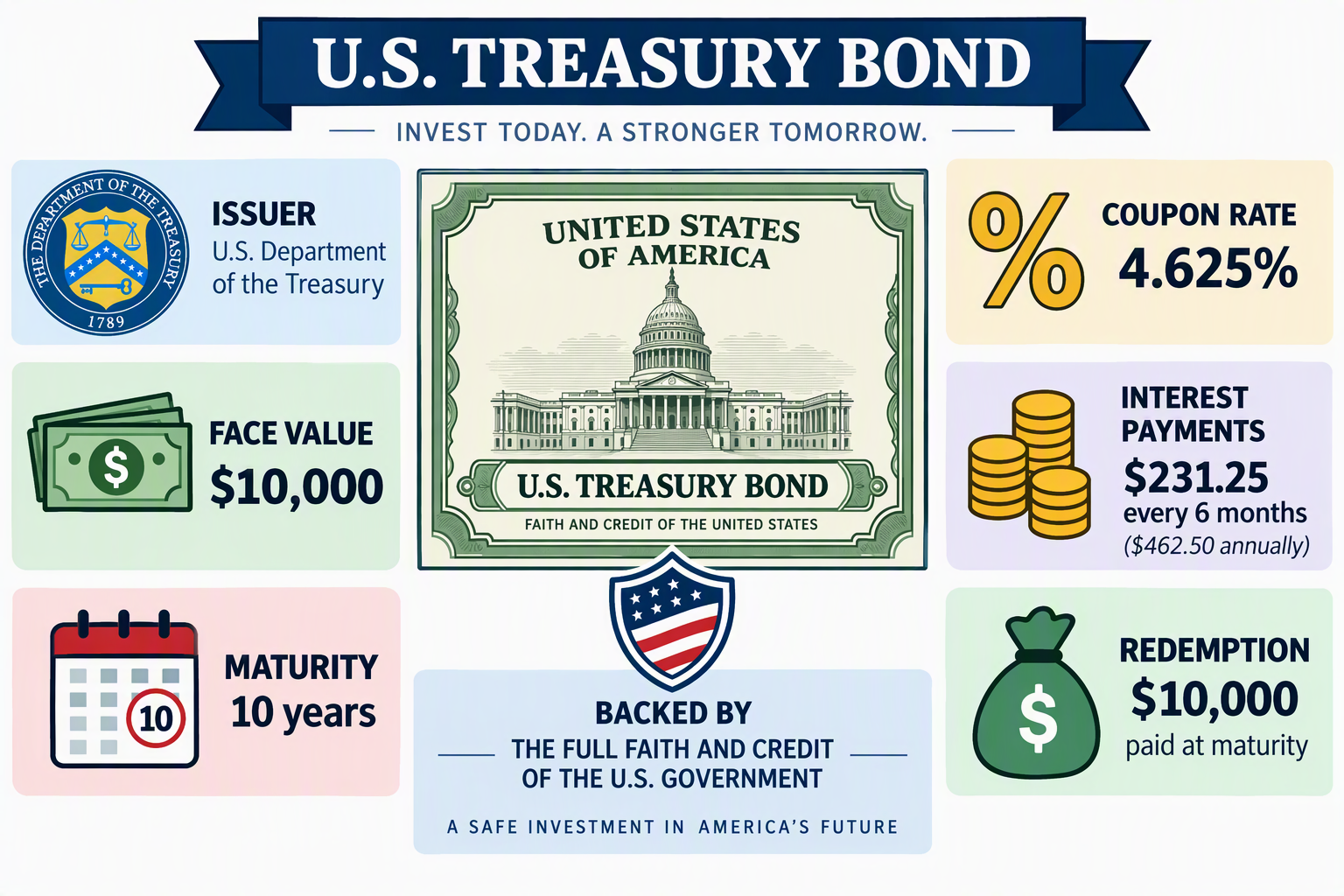
The key parts are:
- The Face Value and Redemption which document the amount borrowed and the amount to be repaid. Almost always, these two values are the same.
- The Maturity documents when the redemption value will be paid back to the borrow.
- The Coupon Rate and the Interest Payments document the fixed rate of return (interest rate) that the bond delivers and how often that amount is disbursed to the lender. In the example above, a coupon rate of 4.655% and a 6 months schedule means that the lender receives a return of $231.25 every 6 months over the course of the 10 years before maturity is reached.
- The Issuer documents who receives the loan and is responsible for the interest and redemption payments.
If someone were to purchase the bond shown above, that someone would receive 10x $462.50 + $10,000 = $14625 over the course of the bonds existence. to judge whether that schedule of income is worth the loan in the first place is where the various time value of money computation come in as the value of $14625 is the absolute dollar amount and does not figure in the fact that the different payments are at different times.
Often, the main buyers of bonds are the so-called institutional investors like insurance companies and pension funds that either want to or are required to hold safe assets. However, since the maturity of various bonds generally sit in the 5-20 year range (with with dispersion), there are occasions where the bondholder wants to get their money back sooner. This ‘exit’ is typically done by trading the bond to someone else who doesn’t mind tying up their money. When the trade is sought, the buyer has to compare the coupon rate against the prevailing rates of other forms of investment and often a bondholder seeking to exit his position has to settle for a ‘below par’ trade, meaning that they get less than the face value.
So, even though bonds are often called fixed income paper to remind (perhaps derisively) that there is seemingly no glamour in owning or trading bonds (again the safe motif), anyone who lived through the fiscal crisis of 2006-2010 knows that the story is more nuanced and will be the subject for further exploration in the months to come.