Uncategorized

Let it Snow (Just not in the Commons)

If you live in the northern stretches of the United States, the winter season brings the distinct possibility of shorter days, colder temperatures, and snow. And with snow also comes the possibility of snowmen, snow angels, snowball fights, white Christmases and so on. But there is also a downside to all this white beauty, the annoying need to cleanup afterwards. However, there is a way to even turn what is typically a boring and even exhausting job into a good reflection on the role that incentives play in the behavior of an individual in an economy. This observation doesn't come from a profound and deep analysis of the impact of meteorology on productivity but was a direct consequence of too much snow and not enough shovelers.

A particularly bad fall covered the area in which I live under 6 or 7 inches of very heavy, very wet snow. The kind of snow that rips branches from their tree and splits trunks in two. The kind of snow that makes roofs creak under the strain, even the steeply pitched ones. The kind of snow that paralyzes governments and strands motorists on highways and byways.

Needless to say, that after the snow had stopped falling and the trees stopped breaking under the strain and the cars stopped being buried came the requisite plowing and shoveling. And the hours wore on as I unearthed (unsnowed?) the walk up to my front door and the sidewalk in front of my house and my driveway and even the four feet of the street in front of it, where the plow truck created a picturesque icy speed bump, presumably to add some excitement in what was otherwise an uneventful day. During those hours I had a long opportunity to consider just what made me and all the other guys on my street motivated enough to do this wearisome and thankless job.

Of course, there are ordinances, regulations, and laws that require homeowners to clear their property, but I doubt that was the primary motivation or even a motivation at all. At least in my case, and I am willing to hazard in the case of my neighbors as well, the motivation was one of house and civic pride. We love and care for our properties. We have skin in the game. It was in the best interest of each household to clean up.

As a result, all the sidewalks of my development, from every bit that hugs the perimeter and to every bit that snake its way through every interior road was clear of snow within 6 hours after the last flake drifted to the ground. Normal life resumed and any resident could walk from one end to the other free of cold, white impediments. Our common areas were collectively free because each of us owned a little slice.

This outcome is in stark contrast to my experiences living in an apartment complex in a nearby town. The apartment complex was big enough that probably the same amount of or more people lived there than all the single family homes where I am now. And the common area was certainly smaller in terms of sidewalks and paths. Nonetheless, almost every resident waited on the landlord’s management company to remove the snow. As a result, apartment dwellers would often be snow bound for a day or more compared to the much more rapid dig out on the order of two to four hours for the home dwellers.

Of course, this snow phenomenon is not new. Economists often talk about how well-constructed incentives motivate people to perform above and beyond what they would do otherwise. For example, endangered species (e.g. rhinoceroses) are better protected from poaching when someone owns the animals rather than just allowing them to be shielded by common protection. The outcomes are better when people have skin in the game. And the ‘skin’ need not even be financially based. Sometimes the incentive takes a more intangible form like the recognition for civic pride that is used to motivate companies to ‘own’ sections of highways that they keep clean.

So, there you have, an economics lesson brought to us by the combination of mother nature and human enlightened self-interest. Who said winters were all bad?

When Cooperation Becomes Collusion

Life often offers us microcosms – little systems that we can examine that reflect the behavior of the whole.  The economy is no different in this regard and often small behaviors and patterns found in a single market reflect larger ones found macroeconomically across the entire webwork of markets.

Case in point, the activities and behaviors found currently in academic peer review of scientific results give an excellent example of how cooperation is not always a good thing, demonstrating in concrete (albeit small) ways the wisdom of the old economic warning

When the people find that they can vote themselves money that will herald the end of the republic.

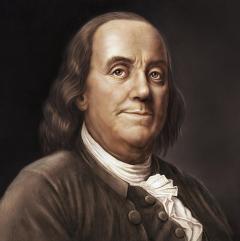
This adage’s attribution remains clouded in mystery with some claiming its origination with Benjamin Franklin at the founding of the United States

Image source: commons.wikimedia.org

while others maintain that it was said by Alexis de Tocqueville or even someone else.

It doesn’t really matter who uttered this maxim.  Whether Franklin said this or whether someone else did or it just arose from the body politic, there’s no denying that it contains an essential truth about cooperation within the economy as a whole.  Namely, that there is a distinction between the kind of cooperation that benefits all members of a society and those kinds of cooperation that benefit only a subset of individuals at the expense of everyone else.

Before delving into the problems with scientific peer review, let’s take a few moments to talk about the good kind of cooperation.

The Federal Reserve Bank of Dallas has a nice discussion of cooperation entitled Free Enterprise: The Economics of Cooperation.  They note that cooperation is desirable, since it pushes “back the limits of scarcity” but that the since scarcity is an unavoidable and fundamental aspect of all economies, competition will inevitably arise.

It is these two forces, when properly mixed, that create the positive dynamic that drives a market economy with cooperation manifesting itself in the division of labor and competition manifesting itself as the creative destruction of the marketplace.  Both forces provide needed efficiencies so that the boundaries of scarcity are progressively pushed back further and further.  Each of these forces, in its own way, makes the best use of the available information within an economy so that the highest value utility for a given set of resources can be achieved.

Cooperation is the mechanism that best circulates existing information.  It creates the environment in which people can share their experiences and their knowledge on the best ways to use existing resources to make the goods and services we use.  The drawback to cooperation is that it doesn’t offer the strong incentives needed to create new knowledge.

In contrast, competition provides the incentives needed for people to discover new knowledge and new methods.  It also provides, through the free-market price mechanism, the innumerable messages an economy needs to be able to decide what is working and what is not.  Its weakness is that encourages compartmentalization and segregation of knowledge.  A healthy economy needs both competition and cooperation working together in proper blend to increase our know-how and to properly share the scarce resources we have.

The Dallas Fed cites two examples of how picking the wrong blend leads to an unbalanced interplay between these two opposing forces.

As a warmup, consider their first example, in which they consider a first come/first served mechanism of sharing resources.  A common example of this is the long lines we’ve seen for people to buy the new release of the iPhone.  This approach incentivizes people to cooperate by forming a queue in which to wait and to compete by seeing who can get there first and wait the longest.  Sadly, both of these outcomes are almost entirely worthless.  The competition doesn’t provide any benefit as nothing new is learned or discovered.  The cooperation side, beyond providing proof that people can coexist without killing each other, it is also without benefit as the line-waiters have been essentially idle during their wait instead of pursuing so useful (if only to them) activity.

Their second example brings us much closer to understanding the staying power of the above economic warning on cooperation.  In this example, the sharing of scarce goods is performed by a government that distributes them. Proponents of government distribution typically justify this method as a way of ensuring that the neediest amongst us get the good and services they deserve.  But, as the Dallas Fed correctly identifies, “the rules of government distribution don’t eliminate competition, they just change the type of competition that occurs.” The fact that an identifiable set of people now control how resources are allocated leads to a warped competition in which lobbyists either persuade, cajole, or otherwise incentivize government officials to make outcomes in their favor.  What they didn’t identify is that this approach also incentivizes an equally warped form of cooperation.

Under government control, cooperation frequently becomes collusion.  For example, it is well known that government regulatory power tends to encourage established firms to spend effort keeping existing regulations in place as a barrier to entry to newer firms.  Government entitlement programs tend to habituate the receivers in a multi-generational cycle of dependency.  And so on.

In the world of modern scientific exploration, government holds the purse strings for grants and announcements of opportunity.  Government officials not only write the terms of these solicitations but also judge the worthiness of every proposal.  Much of the judgement exercised in deciding the merits of a proposal comes from the biases and the preconceptions of these officials.  As a result, there is a premium placed on ‘exciting new studies’ and ‘concepts that generate buzz’.  A researchers end product, typically a portfolio of scientific papers, often becomes a swamp of p-hacking through statistics combined with group think wherein the accepted orthodoxy is reinforced rather than challenged.  William Wilson’s article Scientific Regress discusses the serious issues that have arisen under this system wherein an alarmingly large percentage of papers are simply wrong or irreproducible.

The question is then what is it about the system that allows this type of intellectual snake-oil sales to continue?  The answer is that the citizens (i.e., scientists) of this microcosmic republic (modern, government-backed, scientific enterprise) have figured out that they can vote themselves money by supporting each other in publishing.  Where once there was a healthy balance between competition and cooperation, the trend now is to rely heavily on collusion.  You help me get published and I’ll help you and we’ll all benefit directly by seeing our numbers of publications, times cited, impact factor, and so on increase.  By colluding, we all stand a better chance to receive government funding.

This self-serving behavior is reinforced by a constant mantra about how important science is and how we need to follow the science and how only the most ignorant of us reject the settled science (a as unscientific concept as there ever could be), etc.  The result is that the ‘republic’ of science has heralded it own end.  Ben Franklin, our nation’s first premiere scientist must be turning over in his grave.


Who Profits?

It is a yearly tradition in this blog to simultaneously discuss 1) what makes Thanksgiving worth celebrating and 2) to set the record straight by articulating the first point clearly and refuting the nonsense that tries to drown it out.  This year’s column is no different, although the message comes in particularly well-worded argument by Dinesh D’Souza… but more on that later.

First, just what makes the holiday worth celebrating? (Hint it isn’t a day off, turkey dinner with friends and family, football games, or Black Friday – although the first three of those are nice.)  It is the idea that economic freedom, specifically in the form of private property ownership and voluntary exchange of goods and services, is the ‘magic’ that makes us all prosperous.  Of course, the ‘secrets’ to this magic are nothing more than the recognition that different people are made differently, have different interests and abilities, and, above all, different drives, and the faith that people, left to their own devices, will generally want to cooperate to the betterment of all.

Second, just why does the record need straightening out?  Well there are two reasons.  On one hand, there is simply a lot of misinformation that clutters up the idea landscape.  This economic noise distracts and deceives people from understanding and appreciating what economic freedom means; from appreciating that they control much of what happens in their lives.  This ignorance not only spawns poor decision making it also contributes to the overall unhappiness of any afflicted by it.  On the other hand, there is a certain class of people unwilling to trust that their fellow citizens can manage their own affairs.  This professional busybody class is always poking its collective nose into everybody else’s affairs seeking to dictate and control things that aren’t any of their business.  Ironically, but not unexpectedly, these type of people never subject themselves to the autocratic rule they wish to subject others under.

The story of the first Thanksgiving (nicely summarize here) centers around the Pilgrims realizing that private property and economic freedom matter (see also How Private Property Saved the Pilgrims).  Sadly, this fundamental message is warped and twisted – sometimes innocently, sometimes maliciously – with off-the-mark commentary and argumentation that simply ‘doesn’t follow the science’ (the dismal science of economics that is).  A previous post dealt with some of the most distressing criticisms of the holiday and tried to set some small corner of the record straight but there is always a need for more.

This is where Dinesh D’Souza comes in.  I recently came across a lecture he made in which he presented ideas that solidly support just why the real story of Thanksgiving is worth remembering.  He didn’t tie these ideas directly to the pilgrims so that will be the contribution I provide here.

The tale that Dinesh tells involves a valet car attendant who parks cars at a luxurious resort.  On average the attendant works 10 hours in a day for which he makes $150 ($15/hour).  Over the course of that day he parks 100 cars (10/hour) at the price of $30/car.  The total revenue the resort earns $3000.

D’Souza then discusses how the Marxist looks at what he perceives as an inequity:  the valet, as the main agent, is the one providing the service with his labor but he is only getting a small fraction (5%, in fact) of the revenue.  D’Souza goes on to say (although some inference is needed as there is a cut in the edit) that once the operating costs are subtracted there is still a substantial profit that flows to the owners (the capitalists) which bypasses the valet entirely.  He summarizes Marx’s objection as centering on the fact that the capitalist (precise definition to follow) has already had his recompense through the interest and that the profit should go to the laborer as he is the only one actually producing a ‘good’ in this scenario.

D'Souza then goes on to point out the obvious flaw in this argument.  In Marx’s point-of-view, the capitalist’s only function is to provide the financial power to start the business.  D’Souza correctly points out that the owner (or what he calls capitalist with a more widely expanded definition) does far more than supply working money.  The owner provided three essential ingredients that make his portion of the profit much higher than that of the valet’s:

  • Conception – the owner conceived of the idea of the resort with the necessary appeal to attract people willing to pay $30/day to have their car parked
  • Realization – the owner turned the conception into reality by organizing the countless details, large and small, that make an idea a reality
  • Protection – the owner gets paid last and provides a bulwark against the ebbs and flows of the business cycle to labor thereby giving labor the security of steady wages at the expense of lower profit.

So, how does this narrative tie back into Thanksgiving?  Well, the same passions and resentments that showed up in the valet’s Marxist criticism of the resort’s profit were on display in Plymouth all those years ago.  However, Marx’s facile explanation in terms of the friction between labor and capital doesn’t work so well for the case of the Pilgrims.  The capital for the founding the Plymouth Plantation came from the Company of Merchant Adventurers of London, who remained behind in the old world and, thus, were as far away as conceivably possible at that time (separated by the Atlantic in the early 1600s).  If Marx’s view were correct, why didn’t this laborer’s paradise work from the first go?

William Bradford, who chronicled the events in the fledgling colony, identified how working in common was ‘found to breed much confusion and discontent’.  That the most able bodied complained that they had to ‘spend their time and strength to work for other men’s wives and children without any recompense’.  Where is the worker’s utopia that Marx promised once the worker was freed of the shackles of capital.

In 1623, Bradford took the bold step of abolishing communal labor in favor of private ownership and responsibility.  He turned each family into owners of their own land and a bounty ensued.  In other words private not communal ownership corrected the problem.

To be fair, some of Marx’s observations about the exploitation of the some for the enrichment of others are valid.  Adam Smith also raised concerns about these situations and, as a moral and just society, we should look for mechanisms to address these things.  But the answer, contrary to Marx, isn’t ridding ourselves of private ownership.  Rather, we should be expanding opportunities for more people to own some part of the economic means of production.  As a society, we should offer opportunities for the valet (assuming he is resentful of the role he plays at the resort) to open his own business.  In short, we should reject Marx and embrace Bradford.

Stagflation and the Phillips Curve

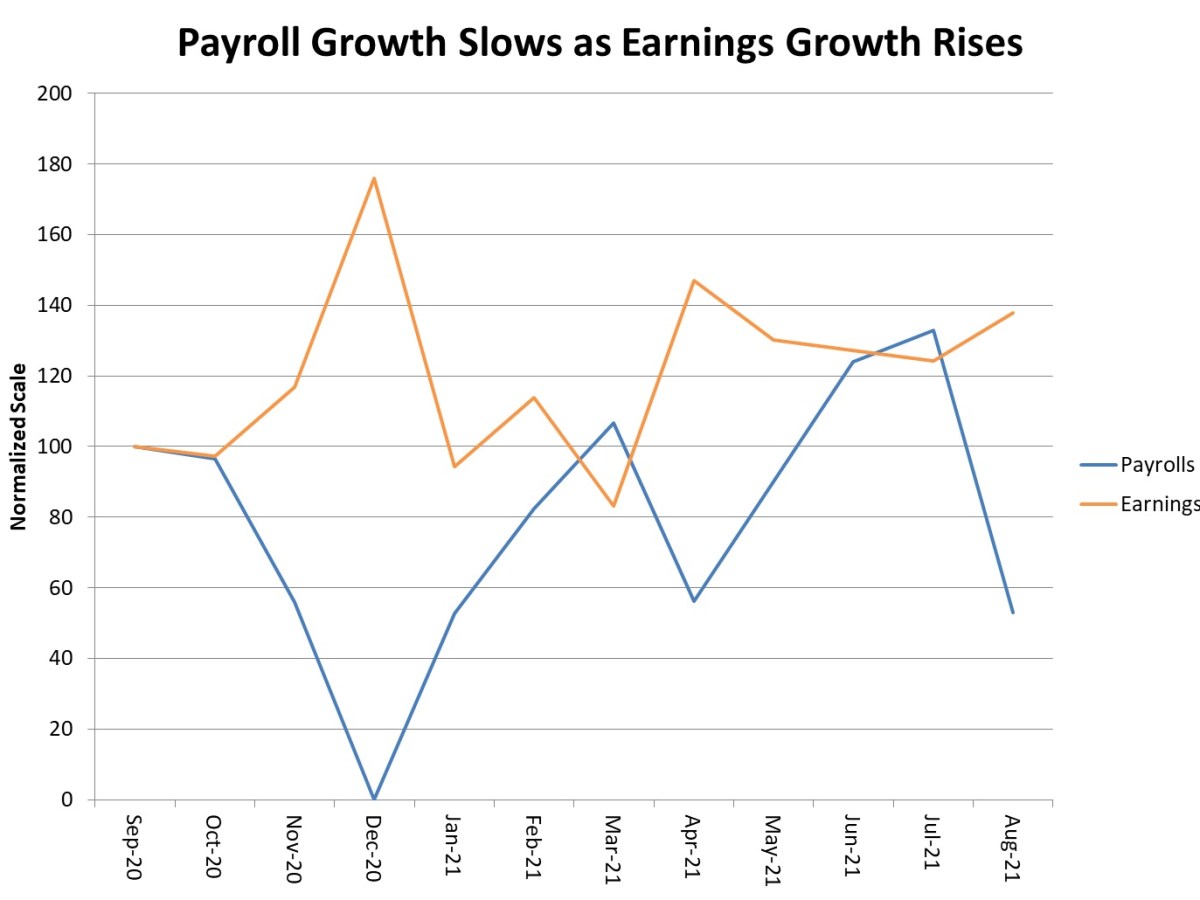
On September 4th of this year, David P. Goldman wrote an intriguing article for Asia Times, entitled Stagflation rears its ugly head in US payroll data.  Goldman presented time series data for job growth (blue curve labeled ‘Payrolls’) side-by-side with data over the same period for wage rates (orange curve labeled ‘Earnings’).  Both series are presented on a normalized scale indicating that the data should be interpreted as roughly percentage changes.  The data show both localized regions (Dec. 2020, Apr. 2021, and Aug. 2021) and mild overall negative correlation between the two curves.  When job growth was down (Nov. to Dec. of 2020) wages rose and when job growth was up (Dec. 2020 to Mar. 2021) wage rates fell.

These observations led Goodman to conclude that stagflation was just around the corner; a conclusion that should scare anyone who had the misfortune of living through the 1970s.

For those who don’t know, stagflation is a period of time in which an economy experiences both high inflation and high unemployment, the latter of which signals slowed or stagnant economic growth.  Prior to the onset of stagflation in the United States from about 1973 to its final defeat in 1984, a firmly entrenched point-of-view in economics circles was that stagflation was impossible because the unemployment rate and the rate of inflation were inversely correlated, with unemployment high when inflation was low and vice versa.

Roughly speaking, the argument to support this beliefs goes as follows.  When unemployment is high, the amount of wages within the economy falls and there are too few dollars chasing too many goods.  The lower relative spending power across the economy necessitates a drop in prices and inflation drops. When unemployment is low, the amount of wages in the economy rises and, conversely, there are too many dollars chasing too few goods.  This time the higher relative spending power causes prices to rise and inflation increases

The empirical data that was used to justify this viewpoint comes from what is now known as the Phillips curve.  The Phillips curve, which was published in 1958 by the economist William Phillips, consists of a scatter plot where each point consists of the unemployment rate and percentage change in wage rates for a given year.  The data for the original plot

Image by Houdinipeter - Own work,CC BY-SA 4.0, Link

show what seems to be a nonlinear negative correlation between these two measures.  The Phillips curve uses the percent change in wage rates as a proxy measure for inflation.

These observations seemed to convince many people that economic policy could rely on a single knob to simultaneously adjust unemployment and inflation.  However, the economy exhibits behaviors more complicated than a simple, approximate one-to-one relationship between unemployment and inflation.

In 1967 and 1968, economists Milton Friedman and Edmund Phelps began arguing that the Phillips curve was a short term trend that resulted from conditions that were not universal.  Friedman’s work centered on the roles of government fiscal and, in particular, monetary policy played in keeping inflation and unemployment under control.

The mathematical structure that Friedman and company used to explain when the conditions are just right for using the Phillips curve (or rather the concepts behind it) is rather complicated and basically involves the recognition that there are two types of unemployment – a natural or structural unemployment, which reflects the fact that at any instant there will be people in the work force who are transitioning from one state of employment to another, and a deviation from this state due to economic uncertainties and fluctuations.  That said, the fact that the Phillips curve can’t hold always is easily seen by the initial heuristic arguments used to support it.

There is simply no reason to believe that when unemployment is high that there would be fewer dollars chasing more goods so that inflation should be low.  Those unemployed workers must have been making goods or providing services to somebody before they became unemployed.  Therefore, there must be occasions where the number of goods falls faster than the unemployment rate raises and inflation must kick in.  Likewise, when the economy is at full employment (meaning that the unemployment rate is at or below the structural rate) workers have more money but they are also producing more goods to be chased.

In any event, whether the theory is understood (or even if it is sufficient to explain all the events of the macroeconomy) is not important because facts bore out the predictions and models roughly 5 years after Friedman and Phelps work in the late 1960s.

In 1971, then President Richard Nixon put into place price and wage controls that shocked the economy.  About 2 years later, in 1973, OPEC cut worldwide oil production.  The US economy went into a recession with high unemployment and high inflation.  The pain of those years is well remembered by those of us who lived through (even and odd days for buying gasoline being one of the most vivid examples).  The stagflation pain persisted for nearly a decade with mortgage rates climbing from a range of 7 to 8 % in the early 1970s, to 16.6% in 1981 (according to Rocket Mortgage’s article Historical Mortgage Rates From The 1970s To 2021: Averages And Trends For 30-Year Fixed Mortgages) – a crushing reality immortalized in comedy in the movie Ghostbusters.

Thankfully, Freidman’s message that inflation is primarily controlled through monetary policy independently of the role that fiscal policy plays in unemployment took hold and decades of prosperour growth followed on the heels of the malaise the US experienced during the bulk of the stagflation era.

Nonetheless, the idea that inflation and unemployment go hand-in-hand persists to this day.  As discussed in an earlier post entitled What Does the Fed Do Now?, even as late 2017 there were people who seriously believed that a single policy could serve to meet the two macroeconomic goals of sustained growth and reasonable prices.  Interestingly, the Fed has, since the time of the publication of that blog, taken down their Chair the Fed game.  A visitor to that old link is met instead with the following message

Chair the Fed:
A monetary policy game

Thank you for your interest in the monetary policy game, Chair the Fed. The game has been a useful and fun tool to learn more about monetary policy. However, the Fed has updated its approach to monetary policy, and the changes are not readily accommodated within the existing structure of the game. As of June 1, 2021, the game is no longer available.

You can learn more about the Fed’s policy updates here. Be sure to also check out FOMC Rewind, a texting video series that summarizes the FOMC’s meeting statements.

Whether this change indicates that the Fed has completely abandoned their previous stance on correlation between unemployment and inflation (the concept behind the Phillips Curve) or whether it was simply politic to stop publicizing it remains to be seen.  Hopefully, like Goldman, they are looking out for the beginning signs of stagflation and are willing and able to make decisions that keep it from doing more than rearing its ugly head.

The Unexamined Communist

Socrates is famous for saying (translated from the Greek, of course) that the unexamined life is not worth living. Unfortunately for us (but certainly not Socrates or Plato) there was no social media in Ancient Greece and, equally unfortunately, that pearl of wisdom seems to have fallen by the wayside in our digital age. Case in point: small minds trolling about in today's hyper-charged hypersensitive Twitter-verse using the apparatus of modern life to condemn capitalism. Using goods and services that are the result of countless free-market decisions, these clowns sit comfortably in a lofty, little perch from which they dish out small, vapid critiques of a system that produced the very infrastructure they use to condemn it. The irony here is beyond anything that could ever have been produced by the thinkers of the Academy and the Lyceum combined.

To fully drink in the incongruity, consider for a moment all the various economic spheres that have to converge to allow a disgruntled, twenty-something-year-old the ability to level criticism against the luxury in which he exists. To be concrete, let’s examine some of infrastructure needed to put up a simple video on YouTube. This analysis is, in some sense, a modern retelling of that venerable article, I Pencil, by Leonard E. Read written in 1958, which shows that literally no one knows all the steps in making something as simple as a Number 2 pencil.

Our scenario will start with our disgruntled content maker, no doubt living in his parents’ basement, with a heart filled with bitterness and a skull mostly devoid of marketable skills but rife with fears (how will I pay my student debt?) and with regrets (why did I ever get that degree in medieval Grail romances?). Having just finished eating dinner (a dinner he did not grow or hunt or even prepare), he washes his hands, uses the toilet, trundles to his air-conditioned cubby, flips on the lights, and logs into his laptop, at which point he is ready to pepper the internet with his injective against capitalism.

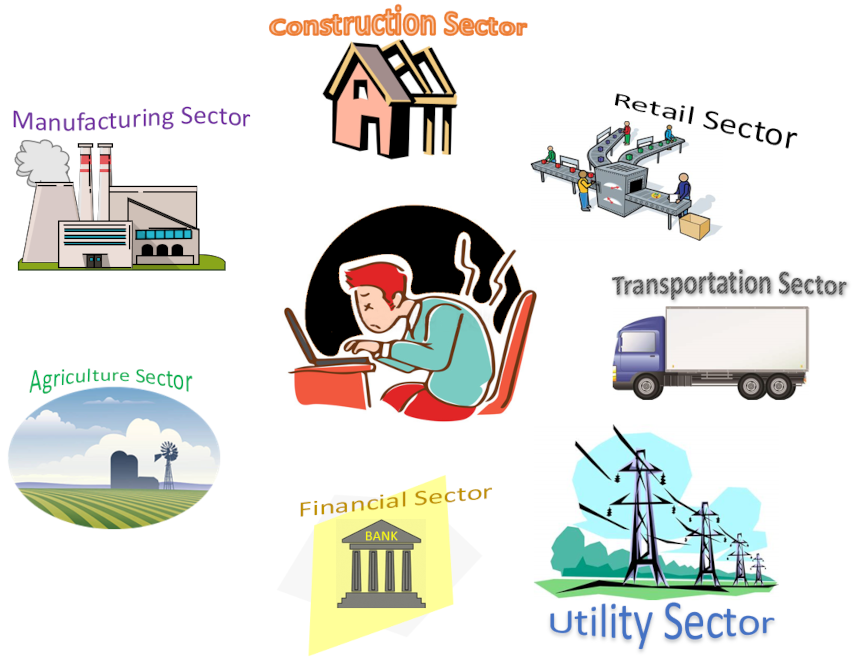
Those simple actions just describe touch upon some of the most important of the economic sectors. The folks at Simplicable, in an article entitled 23 Sectors of the Economy, define what an economic sector is and list their taxonomy. Depending on one’s purpose, other kinds of divisions are possible and common (e.g. academic economists only see four sectors). These details don’t matter as much as the fact the activity that takes place, regardless of dividing lines, are entirely or mostly capitalistic, meaning that private individuals own the means and make the decisions for what is produced, how much is produced, and who gets to consume.

Start with the house itself. Building a house is far more complex than building a number 2 pencil since a house is a set of subsystems or units, each at least as complex as a number 2 pencil, that that all need to work together. First there's the foundation and the actual structure that holds everything up; an incredible mix of concrete, wood, and metal; each serving its own purpose; each bearing its own load. The wood comes from trees in a forest and must move through an intricate webwork of supply chains and activities just to result in a 2x4.

Next, for a house to be considered even remotely habitable in this modern age, it will need electricity. Raw metals, typically copper, will have to be mined and then transported to a plant where it will be transformed into various gauges of wire and various components required for residential use. Circuits will run between the main and various rooms designed to use (one-phase here and two-phase there) and circuit breakers will have to be installed according to codes (a 20-amp breaker here a 30-amp breaker there) that allow us to safely use something that could easily kill us.

Then there's the common need for a heating, ventilation, and air conditioning (HVAC) system. There must be a way getting fresh air into the home, keeping the place heated when it gets cold, and it's highly unlikely that a college-trained intellectual would ever consent to live in a house without air conditioning so we'll check that box too. An HVAC system, all on its own, is a very complicated interplay between multiple economic sectors. Miners find the raw materials that eventually find their way into the sheet metal that is bent to particular specifications to produce ducts, and furnace manifolds, and so on. Certain houses will need specialized lines for handling natural gas safely along with ingenious pilot lights or other auto-ignition systems that enable the system to turn off and on without human intervention. And we can be sure that our YouTuber will want to avail himself of the sophisticated furnace filters that use an internet-of-things approach to automatically notify you when the dirt level demands their replacement (perhaps they will even sponsor his channel). Can’t waste time wondering whether the filters should be replaced when you should be out saving the world from the evils of the profit motive.

The simple action of eating dinner and then washing up afterwards involves multiple economic sectors as well. Agriculture efforts are needed to grow the organic quinoa and free-range chicken he insists on enjoying. A transportation network of trucks, boats, and planes is needed to take harvested goods to the processing plants and then to the supermarkets for his parents to buy.

Then there is the financial sector that enables his parents to put gasoline in their hybrid and drive to the local market where they pay with cash-back or points-reward credit card. This infrastructure, which allows them to enter a store, pick 32 specific items, checkout and drive home without ever handing over any cash goes completely unnoticed. This very same infrastructure also enables the mortgage on the house, the insurance premiums and payouts, and numerous other transactions, large and small that keep the household running smoothly.

Going hand-in-hand with the financial sector is retail. The ability to have innovative people realize an idea into a product that betters our lives would not be possible without the financial underpinnings of investments. These investments permit businesses to higher labor, design new goods and services, and purchase the assembly plants and distribution centers that turn these designs into things we consume. Companies, like Amazon and Apple, use this retail model to continually feed our man with the electronic products he craves; the ones that will allow him to make that one viral video that will change the world.

But no economic sector is, perhaps, as important to our modern-day hero than the utility sector. Ignore for the moment (as does he) the fact that this sector pumps the fresh water that he and his family need to drink and bath straight into the home (no trips to a well for someone whose mission is to save the world from private enterprise). Rather, focus on the those ever-so-vital electrical interactions that make modern life possible: the power that runs the air conditioning and the washing machine and the dish washer and the refrigerator; as well as the signals skipping to and fro bringing connectivity to the social media platforms that will carry his liberating manifesto to all the oppressed so that they may throw off the shackles of their high standard of living.

This narrative, of course, only scratches the surface. There are countless other ‘capitalist-enabled’ interactions that this poor deluded soul engages in. Retail stores, like Home Depot and Lowe's, provide the basic products like carpeting and the drywall that make his house comfortable. Vendors, like Hobby Lobby or Home Sense, provide the decorations and little knick-knacks that make a house a home. There are also the countless innovations, from fiber optics to CCD cameras to compact microphones, that connect to his laptop for the express purpose of making a video in which he can decry, with a huge helping of hubris, the evils of the system that enables his incredible style of living.

In the end, instead of having a hero of the people we have a person totally devoid of self-reflection or even an awareness of the bigger community into which he belongs who rails on social media about the inequities of the system and who speaks affectionately for communism. And all because it is easier to look at the capitalist system and find within it the conspiracy that explains his failures than it is for him to own them. Maybe he should have gone to a vocational school where he could have learned to weld. He wouldn’t be as plugged in to the revolution but at least he wouldn’t be living in his parents’ basement.

The Unintended Pharmacy

Sometimes our plans simply don’t go the way we want or expect them to go.  Occasionally we are simply victims of bad luck but, more often than we care to admit, the fault lies not in our luck but in ourselves in that we failed to think things through before we began.  And, sadly, on many of these occasions our own failures result from willful blindness rather than innocent ignorance.  Case in point: Walgreens and the City of San Francisco.

To give a short summary, Walgreens has shuttered a number of pharmacies within the city of San Francisco in the past several years due to widespread theft (Shoplifting Has Forced Walgreens To Close 17 Stores; Walgreens Closes 17 Stores In San Francisco Because Of Rampant Theft).  Jason Cunningham, regional vice president for pharmacy and retail operations in California and Hawaii, is quoted in The San Francisco Chronicle saying that

[t]he cost of business and shoplifting led Walgreens to shut 17 locations in San Francisco in the past five years — an “unpopular and difficult decision.

Cunningham offered the following statistic to support his claim about shoplifting:

[t]heft in Walgreens’ San Francisco stores is four times the average for stores elsewhere in the country, and the chain spends 35 times more on security guards in the city than elsewhere.

This story might be a mere footnote in the business columns were it not for the fact that it is almost a textbook example of how willful blindness (or worse) results in what economists call unintended consequences.  In a nutshell, both the City of San Francisco and Walgreens hold viewpoints and enacted policies that, to the untrained eye, seem to be compassionate, but which ended up harming the same vulnerable people which these parties claimed they want to help.

Of course, the idea of unintended consequences is not a new one in economics circles.  EconLib has a nice summary of this topic, in which they point out that the idea first appeared in Adam Smith’s The Wealth of Nations.  Smith’s Invisible Hand describes the positive unintended consequences whereby each individual, following his own self-interest, helps to build a healthy, thriving society.  In modern times, the phrase ‘unintended consequences’ usually carries a negative connotation and has come to mean all the bad things that result from some policy enacted by either blind, but well-meaning, politicians or by sinister opportunists who sell the willfully blind a bill of goods.  But, regardless of whether the consequences are good or bad, all of us are obligated to make sure that they are at least intended; a point-of-view most forcefully expounded by Frederic Bastiat.

What is new is just how clueless the residents of the City by the Bay are in making good, or rather bad, on their compassion.

Let’s start with the muddle-headed thinking of the city government.  In April 2018, the San Francisco legislature, in all its wisdom, deemed shoplifting goods valued at less than $950 a misdemeanor, thereby removing a strong disincentive to theft.  Some in city government view shoplifting as a petty crime not worth enforcing but as anyone familiar with the concept of the broken window syndrome knows, smaller crimes beget bigger ones and a failure to enforce laws invites lawlessness.  In addition, the more recent, widespread antipathy towards the police has emboldened the criminal element across the country.  No doubt, other members of the government likely believe that they are showing understanding and compassion towards the marginalized (a la Cynthia Nixon’s recent comments) or they are shamelessly virtue signaling because they live in areas unlikely to be impacted by their decisions.  But, as will be demonstrated below, all that this point-of-view does is harm the most vulnerable.  Regardless of the interplay between all these motives, the result is a theft rate in Walgreens four times higher than stores in the rest of the country.

Walgreens is not entirely blameless in this as well.  No doubt due to both political reasons and matters of liability, the pharmacy chain has taken a non-confrontational approach to shoplifting in its stores.  According to anonymous reports from employees on reddit, Walgreens instructs its staff to do nothing to stop a shoplifting incident but to simply report it after the perpetrator has left the building. Once the cops arrive there is really very little that they can do, even if the courts would have been zealously prosecuted the offenders.

Finally, some of the most vocal residents of these very neighborhoods also don’t get it.  The Mission Local ran an article entitled 'Shame on Walgreens,' neighbors petition store plagued by shoplifting not to close.  The article cites the petition as describing one Walgreens in particular as a

…lifeline for many seniors, people with disabilities, and low-income residents who cannot go further out to other stores to get what they need. The other Walgreens that is 3 blocks away is not handicapped accessible and cannot accommodate people with disabilities.  Walgreens Corp. has an annual revenue of around $139.5 billion.  We think they can afford to keep needed stores like this open.

The same article goes on to quote the poster boy of willful blindness, a jackass by the name of Curtis Bradford as saying

In the middle of a pandemic and crisis, we cannot allow profit driven greedy Corporations to further traumatize and abandon their responsibility to the community. People over Profits! Especially during the worst crisis we’ve faced in a generation. Shame on Walgreens[!]

To these residents Walgreens should just hang in there and take it since they have deep pockets; the greater good is taking care of the vulnerable and the elderly in the Mission District.  Not once did the article cite a resident who organized a neighborhood watch to thwart shoplifting or member of the community who setup ‘pony express’ with runners who would go the 3 blocks mentioned and retrieve those lifeline goods.

To recap:  we have an envious and apathetic public who, in adding one part free rider problem and one part moral hazard to their witches brew, creates a potion that allows them to blindly and willfully ignore that Walgreens has rights and that it exists to be in business; we have a pathetic and timid business in Walgreens, who, in trying to avoid direct confrontation, has blindly and willfully ignored their obligations to employees and stock holders; and we have group of demagogues and opportunists who, in trying to capture the politically correct high ground, has blindly and willfully refused to mete out justice.  And who suffers from all this willful blindness and unintended consequences?  The very people each of those aforementioned groups no doubt claims to protect.  If it weren’t so sad it would be downright funny.

The Economics of the Colonial Pipeline Incident

The recent cybersecurity incident involving the Colonial Pipeline offers an incredibly rich vista for exploring a variety of economics concepts. Questions about what went wrong and how to prevent this in the future naturally dovetail with the fundamental questions of economics centering on scarcity, who produces, who consumes, and how much.  This post will touch on the public’s non-intuitive (and to many infuriating) behavior in response to the gasoline shortage, questions about market forces and corporate responsibility, and the role of regulation.

But before getting to the analysis a brief recap is in order.  The colonial pipeline provides a large percentage (approximately 45%) of gasoline to the eastern United States ranging from the Gulf Coast (eastern Texas and Louisiana), through the south, up along the Carolinas, into the mid-Atlantic states, and into New Jersey and Pennsylvania.

On May 7, 2021, the pipeline was the victim of a ransomware attack, and the company halted all flow to mitigate the attack, which, reportedly, did not disable pipeline operations but infrastructure support (e.g. billing).  Even though the company almost immediately paid the requested ransom of 75 bitcoin, equivalent to approximately 5 million dollars, it took about 5 days to totally restore operations and at least a week beyond that for the entire system to return to normal.   During the 12 to 14 days of the disruption, the entire customer base suffered, to varying degrees, long gasoline lines and a general shortage of gasoline.  Stories about some individuals hoarding the supply surfaced along with widespread speculation about Colonial’s vulnerability to cyberattacks, and as always, the role that government and regulation should play in these situations became a common topic of conversation.  This post will content itself with only some of the highlights.

Foremost of these was the public response to the scarcity of gasoline.  Once the pipeline shut down, it was only a matter of time before the amount supplied dropped and the price increased.  Common wisdom argued that these price increases would trigger a drop in quantity demanded resulting in motorists in the effected area minimizing their trips in a car.  This interplay between supply, price, and demand is the traditional prediction of classical economics thinking.  What happened was a bit more intriguing.  If reports are to be believed (as should likely be the case), as the amount of gasoline supplied went down and the price rose, the demand actually increased to a greater level than had been the case prior to May 7th.

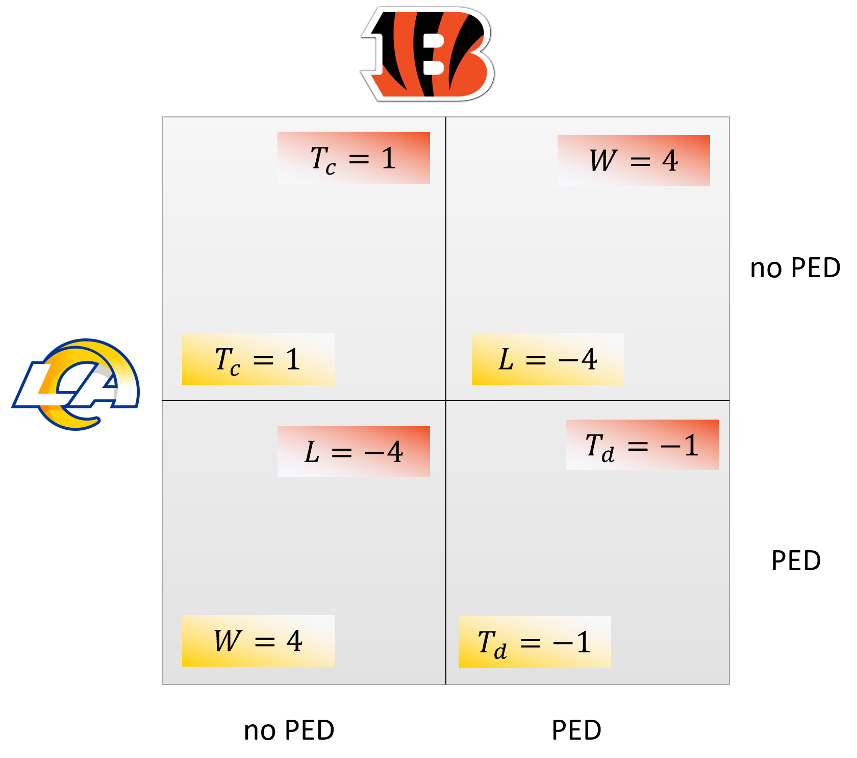
The most probable mechanic behind this paradoxical behavior (at lease according to classical theory) seems to be related to the prisoner's dilemma.  Each member of the gasoline-consuming public could have looked at the situation and said “This disruption won't last long.  One way or another gas supplies will increase soon and so I'll cooperate with my neighbor; I will limit my gasoline purchases alleviate the crisis.”  However, as in the traditional prisoner’s dilemma, there is a rational fear of being betrayed by other actors in the drama which pressures each participant to betray as well.  Each person imagined the possibility of limiting their gas purchase and then came face to face with the fear that the supply of gasoline he really needed would be unavailable if his neighbor, thinking about the situation in the same way, reacted by rushing out to buy more gas than he absolutely required.  This self-enforcing negative feedback, which looks to have actually happened, was labeled by the media as ‘panic-buying’ but it seems to be based on something far more rational than blind fear.

The second interesting point to consider is if market forces could have been marshalled that would have led to a better outcome.  Obviously, Colonial Pipeline had been vulnerable to this cyberattack but the reason for that vulnerability isn’t forthcoming and, given the sensitive nature, is likely to never be fully known.  Nonetheless, this lack of information shouldn’t stop a vigorous analysis of what might have been done differently (although it should stop people jumping to conclusions – but it won’t).  The starting point will be the very practical question: did Colonial Pipeline take cybersecurity seriously?

There are practical reasons why any business entity (individual, family, corporation, education institution, etc.) might actually choose to ignore steps to beef up its cybersecurity.  As argued by Cormac Herley in his article entitled So Long, And No Thanks for the Externalities: The Rational Rejection of Security Advice by Users, security measures that cost more than the incident they intend to prevent are a non-starter.  It is possible that Colonial Pipeline recognized the need for cybersecurity but could only afford so much and they knowingly and calculatedly set aside money for a ransomware attack.  After all, ransomware attacks are meant to be annoying not debilitating and paying 5 million dollars occasionally may be more cost-effective than spending 30 million each year on IT.  The group allegedly behind this has even stated that they had no intention of causing this much trouble precisely because trouble triggers investigations and they simply want money.

There are always those amongst us who would argue that a company should ‘do the right thing’ regardless of cost but what, exactly, is the right thing.  Would customers be willing to pay 4 cents more per gallon to ensure that this kind of thing would be far less likely in the future?  Ask the motorist who was waiting in a 2-hour gas line the answer is likely to be yes but ask that same motorist now that the situation has returned to normal his answer will likely be no.

Perhaps there is a way for Colonial to market their socially responsible position but that notion is farfetched.  Most of us know our local gas stations not the company(ies) that they deal with to get gas in the ground for us to pump.  Colonial would have to spend millions raising social awareness before they could even begin to recoup that investment and apply it to their efforts in beefing up their cybersecurity.

Finally, there is the overall question of regulation given the optics of this event.  The public seems to have acted irrationally and, at lease in some eyes, Colonial Pipeline was also irresponsible for lapses in security and being craven in paying the demanded ransom.  No doubt some politicians are considering if this situation clearly invites government stepping in and declaring Colonial Pipeline as a public utility.  Arguments will surely surface that government needs to do more to ensure that companies keep current in their cybersecurity posture and, given the high-profile nature of this incident and the current ongoing federal involvement, future mandatory compliance seems certain.  The regulatory burden that will result will likely be far more expensive than a thorough internal approach.  This is the real bottom line incentive for ‘doing the right thing’; that the cure will be worse than the disease.  So, it seems that the Colonial Pipeline incident is literally the gift that keeps giving to professional economist.

Scholars and theorists will be busy for decades analyzing every nook and cranny, from new variants on the prisoner’s dilemma, to better market forces designed to incentivize corporate responsibility and the role that government regulation should play in cyberspace.  Sadly, for the rest of us, it is a reminder of how the digital world of ones and zeros can have a big impact on the real world of dollars and cents.

The Lemelson Debate

An old adage says there are always two sides to every story and this is certainly true about the life and controversial career of inventor Jerome Lemelson.  What makes his tale so different from other public, polarizing figures is that the arguments traded between his admirers and his detractors concerning his use of the US patent system reflect, in a microcosm, two dramatically different points-of-view about how inventions and intellectual property should be governed in society.

When one thinks of the great inventors of American history, one might conjure up Thomas Edison or George Eastman or Samuel Westinghouse.  Each of these men is famous for bringing to market, some device or machine that changed the way we live.  For example, George Eastman, dissatisfied by his experiences getting a photographic portrait, invented photographic film and the first portable camera and revolutionized how we record history, be it the small, private kind we each enjoy or the collective, public kind that shapes the doings of the world.  However, it is rare to find a person for whom the name Jerome Lemelson is even known let alone a household name, on par with those listed above, despite the fact that Lemelson holds approximately 600 US patents, making him one of the most prolific patent holders in the world.

That portion of the world that does know him divides into two very diverse camps.  His admirers think him a visionary who made our modern life possible.  His detractors think him a hoarder who gamed the US patent system and, perhaps, was a forerunner of the modern patent troll.

The pro-Lemelson side is succinctly presented in the Smithsonian book Little Explorer - Jerome Lemelson: the Man Behind Industrial Robots, by Lucia Raatma. (Note similar stories are told in the book Inventors You Should Know: Profiles for Kids, by Sam Simon– both are available on scribd.com)


The book provides a brief biographical sketch noting that Lemelson, born July 18, 1923 in Staten island New York, earned an engineering degree from New York University despite having his studies interrupted by service in World War II.  After graduating, Lemelson started in a typical salaried engineering job before striking out on his own as an inventor.  The book claims Lemelson’s most successful invention as the universal robot that would use one of his earlier patents on machine vision, which Lemelson imagined as a computer analyzing images from a video camera, to study a task and then “figure out the best way to complete it”.

Raatma also spends some time talking about Lemelson’s approach to business.  She says of his licensing and patent prosecution efforts that “an important part of being an inventor is licensing one’s ideas.  People can’t buy new items if they don’t know they exist.”  To that end he founded the Licensing Management Corporation to “sell his ideas” and to file lawsuits to protect his intellectual capital.  The money he derived was then returned to the community in the form of philanthropy designed to help budding inventors.

A more critical looks at Lemelson’s career is found in A History of Inventing in New Jersey: From Edison to the Ice Cream Cone, by Linda J. Barth.   She concedes that, despite his philanthropy, his career mostly consisted of filing patents and suing companies and customers who, allegedly infringed them, an approach she was clearly uncomfortable with.  Barth characterizes him as “not conduct[ing] much laboratory or manufacturing work” and she relates the following anecdote to drive home the point that much of his activity centered on litigation.

An example is a suit against Kellogg cereals. Lemelson submitted to the cereal company an idea for printing a children’s mask on the box that could be cut out and worn. Kellogg dismissed the idea, as it had used cut-out masks in the past. Lemelson then obtained a patent for his particular mask and later sued Kellogg when he saw a printed mask on a box of Corn Flakes.

In her closing paragraphs, Barth writes

Today, the Lemelson debate goes on. …On the August 20, 2005 broadcast of ABC News, Adam Goldman said “to his many detractors, Lemelson’s patents were, in fact, worthless.  Lemelson, they say, was one of the great frauds of the 20th century.

In the article Down but Not Out, R.  P.  Siegel points out that Lemelson’s inventions were “often so far ahead of their time that, in many cases, the technology required to build them did not yet exist.” Siegel also goes on to say that “a big part of Lemelson’s success was that he filed patent applications that remained pending for decades, and delayed work to his advantage.” Since patent applications remain hidden until the patent is granted, decades of delay on Lemelson’s part meant that other companies would unintentionally ‘re-invent the wheel’ by bringing a similar idea to market only to find later that they were subject to an accusation of patent infringement.

These so-called submarine patents enabled Lemelson’s Licensing Management Corporation to extract hundreds of millions of dollars from companies around the world.  Siegel cites that Las Vegas Judge Phillip M. Pro, who ruled 14 of Lemelson’s patents as “invalid and unenforceable” partially due to the submarine aspect but partially for lack of enablement, which means that no person skilled in the art could produce the device based on the teaching of the specification.  According to Jesse Jenner, the lead attorney representing Cognex, a company that disputed Lemelson’s claims of patent infringement, “these … rulings assert that no one, including Lemelson’s himself, ever built the machine vision system or bar-code scanner he licensed to thousands of companies.”

The idea that Lemelson’s patents are fraudulent is vocalized most forcefully by Mike Masnick, in a post entitled Lemelson’s Legacy: Great Inventor or Patent Hoarder, in which he characterizes Lemelson as a “complete fraud” who hoarded ideas and patents that effectively held companies, who actually did innovate and perform the hard work needed to bring a product to market, for ransom.  Masnick concludes by describing Lemelson as being “more a science fiction writer than an inventor” and that “crediting Lemelson with machine vision is like saying Jules Verne invented space travel.”

So, what to make of Lemelson?  In the process of wrestling with the facts surrounding his career, one must inevitably ask what the role of idea versus industry is in the economy.  Certainly, having a good idea is a commodity that should reap an economic reward and one’s immediate sympathy most likely goes to the ‘idea holder’ and, by all accounts, Lemelson had ideas.  But a bit of reflection should walk one away from the perspective that the ‘idea holder’ is pre-eminent.  If it is simply a matter of having an idea a without having the will power and means to bring it to fruition, then Lemelson should not be credited with the invention of the industrial robot anymore than anyone else who came after GK Chesterton.

Chesterton, who cared little for machines and industry and modern economies, introduced the concept of the robot in his short story The Invisible Man, in 1911, roughly two decades before Lemelson was ever born.  In this story, Chesterton foresees a future layered littered with mechanical helpers:

The man called Angus emptied his coffee-cup and regarded her with mild and patient eyes. Her own mouth took a slight twist of laughter as she resumed, “I suppose you’ve seen on the hoardings all about this ‘Smythe’s Silent Service’? Or you must be the only person that hasn’t. Oh, I don’t know much about it, it’s some clockwork invention for doing all the housework by machinery. You know the sort of thing: ‘Press a Button — A Butler who Never Drinks.’ ‘Turn a Handle — Ten Housemaids who Never Flirt.’ You must have seen the advertisements. Well, whatever these machines are, they are making pots of money; and they are making it all for that little imp whom I knew down in Ludbury.

As Smythe took the handles and they turned the great corner of the street, Angus was amused to see a gigantesque poster of “Smythe’s Silent Service,” with a picture of a huge headless iron doll, carrying a saucepan with the legend, “A Cook Who is Never Cross.”

“I use them in my own flat,” said the little black-bearded man, laughing, “partly for advertisements, and partly for real convenience. Honestly, and all above board, those big clockwork dolls of mine do bring your coals or claret or a timetable quicker than any live servants I’ve ever known, if you know which knob to press. But I’ll never deny, between ourselves, that such servants have their disadvantages, too.

“Indeed?” said Angus; “is there something they can’t do?”

“Yes,” replied Smythe coolly; “they can’t tell me who left those threatening letters at my flat.

A critic might be inclined to point out that Lemelson did more that have an idea, since one can’t just patent an idea, but that point is fairly well retired by both the Corn Flakes anecdote above and the fact that, as Judge Pro ruled, many of Lemelson’s patents could not actually be used to build a device that achieved the idea.

Sad to say, it seems that Lemelson’s usual bag of tricks was to dream up an idea any futurist might have and then to slap just enough ‘hard science’ onto it to serve as a fig leaf covering the basic fact that his ideas were naked.  He then seems to use the strategy in dragging his applications out until real inventors, independently having similar ideas, caught technology up to the point where an actual device were possible.  At that point, Lemelson surfaces and sues real innovators who had never heard of either him or his shadow idea.  This is clearly not an actual desirable good in society and any economic rewards along these lines merely incentivizes more of the same and more waste on the part of individuals and companies that really invent.  Thankfully, Congress put an end to the submarine patent with the Uruguay Round Agreement Act in June 8, 1995.  Hopefully we won’t see another Lemelson as long as we live.

Oh, the Economics You Can Play

Human behavior.  There is simply no way to avoid thinking about human behavior when talking about either politics or economics.  The political side makes assumptions and then argues about what is right and proper and ought to happen.  The economic side observes and then poses questions about the best way to answer how much, who makes, and who consumes.  The political sphere tends to value emotion over data, and the cost of each decision is ‘obvious’ and ‘visceral’ and ‘in your face’.  In economics, the situation is reversed, with hard facts trumping knee-jerk reactions, and where the costs of each decision are often ‘hidden’ and ‘counter-intuitive’.  And yet both disciplines deal with the same underlying enigma – human beings.  As a result, it is almost always the case that there is spillover between the two sides, in which the salt water from the political ocean mixes with the fresh water from economic rivers that fed it to form a sort of brackish overlap.

This past month saw a particularly interesting ‘brackish’ situation emerge surrounding one of the most colorful characters in literature, Theodore Seuss Geisel aka Dr. Seuss.

According to Wikipedia, Ted Geisel authored over 60 children’s books.  According to the stack of books that once adorned the shelves in my own children’s room, we owned nearly all of them.  There’s no denying that Dr. Seuss was a common fixture for many when learning to read.  There’s also no denying that as many of us transitioned to adulthood, our childhood love of the perennial favorites The Cat in the Hat, The Lorax, Fox in Socks, and Horton Hears a Who! came along for the ride (not to mention our yearly need to see the Grinch in the weeks leading up to Christmas).  Seuss’ work resulted in numerous movies, TV shows, and related media (including a hilarious reading of Green Eggs and Ham by Jesse Jackson on Saturday Night Live).  Dr. Seuss wove himself and his eccentrically drawn characters into the fabric of American life (but just how deeply will be discussed below).

It is against this backdrop that a controversy erupted early in March when the publisher, Dr. Seuss Enterprises, announced that they would no longer be printing the following 6 titles:

  • And to Think That I Saw It on Mulberry Street,
  • If I Ran the Zoo,
  • McElligot's Pool,
  • On Beyond Zebra!,
  • Scrambled Eggs Super!, and
  • The Cat's Quizzer.

This sparked a political firestorm on both sides of the spectrum, but the controversy lasted far shorter than the publishers most likely had hoped.  But before arguing the underlying facts that support this, admittedly, provocative conclusion, let’s look at what the politics had to say in order to better understand how their emotional response provided cover for what was most assuredly a savvy economic move on the part of Dr. Seuss Enterprises.

According to Yahoo! News in a piece they published on March 2nd entitled Six Dr. Seuss Books to Stop Being Published Due to Racist Imagery: 'Hurtful and Wrong', Dr. Seuss Enterprises has decided to stop publishing the list of 6 books by the late author because of “racist and insensitive imagery.”  The article went on to quote the publisher saying that the titles in question:

[P]ortray people in ways that are hurtful and wrong.  Ceasing sales of these books is only part of our commitment and our broader plan to ensure Dr. Seuss Enterprises' catalog represents and supports all communities and families.

Newsweek, in their short piece entitled Banned Seuss Site Emerges to Promote Dr. Seuss' Six Canceled Books, cites a 2019 study published in Research on Diversity in Youth Literature, which concluded that

Geisel, however, has a history of publishing racist and anti-Semitic work.  [Of the] 50 books [we examined, we] found that 43 out of the 45 characters of color featured in those books have "characteristics aligning with the definition of Orientalism," or the stereotypical and offensive portrayals of Asia … [and] the two "African" characters both have anti-Black characteristics.

According to Newsweek, the study describes anti-Blackness as discrimination, opposition or hostility against Blackness and Black people.

On the other side of the political spectrum, local radio commentators complained about cancel culture, and wondered how the cancel culture could accuse the man who put environmentalism front and center in The Lorax, and tolerance despite outward differences as the central theme in The Sneetches, of being racist.

Of all the media outlets, the NY times, in its piece entitled Dr. Seuss Books Are Pulled, and a ‘Cancel Culture’ Controversy Erupts, comes closest to identifying what was really going on.  After stating that:

The estate’s decision — which prompted breathless headlines on cable news and complaints about “cancel culture” from prominent conservatives — represents a dramatic step to update and curate Seuss’s body of work, acknowledging and rejecting some of his views while seeking to protect his brand and appeal.

the Times finally points out to its readership that

[Seuss’ c]lassic children’s books are perennial best sellers and an important revenue stream for publishers. Last year, more than 338,000 copies of “Green Eggs and Ham” were sold across the United States, according to NPD BookScan, which tracks the sale of physical books at most retailers. “One Fish Two Fish Red Fish Blue Fish” sold more than 311,000 copies, and “Oh, the Places You’ll Go!” — always popular as a high school graduation gift — sold more than 513,000 copies.

“And to Think That I Saw It on Mulberry Street,” one of the six books pulled by the estate, sold about 5,000 copies last year, according to BookScan. “McElligot’s Pool” and “The Cat’s Quizzer” haven’t sold in years through the retailers BookScan tracks. Putting the merits of the books aside, removing “Green Eggs and Ham” would be a completely different business proposition from doing away with new printings of “McElligot’s Pool.

And there you have it: the decision by Dr. Seuss Enterprises (DSE) was nothing more than a clever marketing ploy.  DSE could have simply stopped printing underselling books, but they knew that a perceived ban would trigger responses from both sides generating loads of free publicity.  They timed their announcement to coincide with National Reading Day, which is March 2nd, a date previously chosen to coincide with Ted Geisel’s own birthday.

And their ploy worked like a charm.  The price of the ‘forbidden fruit’ rose so fast on Ebay that, as CBR notes in its article entitled 'Banned' Dr. Seuss Books Delisted on eBay After Selling for Thousands,

After news about six Dr. Seuss books being pulled from the marketplace led to skyrocketing sales online, eBay responded by delisting the six books.

The prices on eBay were becoming exorbitant, with collections of all six books going for upwards of $5,000. That changed late Wednesday into Thursday as eBay delisted the six books from the auction/online sales website.

One seller who had sold a copy of one of the discontinued books received an e-mail from eBay pointing out that the site would not allow the book to be sold because of its "offensive materials policy," explaining that “Dr. Seuss Enterprises has stopped publication of this book due to its negative portrayal of some ethnicities. As a courtesy, we have ended your item and refunded your selling fees, and as long as you do not relist the item, there will be no negative impact to your account.

The only thing lacking in DSE’s plan was the ability to control the duration that a fickle and easily-distracted public either would stay outraged by ‘cancel culture’ run amok or would remain bitter towards perceived injustice.  The controversy ended far too quickly to likely sustain an increased jump in sales but that doesn’t really matter.  What does matter is that the roots of the controversy were planted firmly in the bedrock of economic analysis and not in the political winds that blow this way and that.

A February to Remember

Their trading company of choice is called Robinhood, the subreddit where they discuss and plan is called r/wallstreetbets, and their now trademark move is called the GameStop short squeeze, but a name has yet to attach to the group of retail investors who’ve jumped into the spotlight for their role in one of the landmark incidents in the world of high finance.  Whatever name history eventually dubs these ‘average joes’, there is no doubt that their actions – which are one part David versus Goliath and one part Revenge of the Nerds – have bloodied the nose of high finance and will change the way Wall Street, Congress, and society at large looks at investing and stock trading going forward.

Despite the excitement and drama surrounding the movement of GameStop stock during the past month, the mechanics of the story are rather simple, although, perhaps, couched in unfamiliar terms.  A group of institutional traders (e.g., brokerages, hedge funds, etc.) decided that GameStop was an over-valued company and shorted the stock.  These actions were followed by the retail reddit investors driving the stock price up in a squeeze that caused big financial losses for many of those institutions.

In a short, the trader, called the short seller, borrows the stock from a lender and sells it to the broader market at the price Pb (‘b’ for borrow).  The short seller, in addition to paying a lending fee, has an obligation to buy the same amount of the stock back and return it to the lender at some future time.  During the time between the loan and the repayment, the short seller must collateralize the loan with a cash holding called margin, and may have to post additional margin as the stock price moves.

As long as the future price Pf (‘f’ for future) is lower than the Pb, the short seller stands to make a profit equal to (Pb – Pf)*n (with n = number of shares), which is his reward for correctly betting against the stock.  But if the future price is greater than the borrow price, the short seller loses money, and since there is theoretically no limit to how high a stock price may go, the corresponding losses are unlimited.

By rule, whenever a trader takes a short position (i.e., short sells a particular stock), it is publicly disclosed; this disclosure has both a downside and an upside.  On the downside, the fact that someone has bet against the stock puts a downward pressure on the price of that stock, which strengthens the short seller’s chances of realizing a profit.  On the upside, the public position of that bet makes the trader vulnerable to others pushing the stock price higher, forcing the short seller to increase his margin (held collateral) or to exit his short position at a loss.  This later event is an example of what is called a short squeeze, and is precisely what the group in r/wallstreetbets did.

As Jill Schlesinger points out in the following video, what makes this story ‘delicious’ is that, in crowdsourcing this short squeeze, the retail investors of this world (so-called dumb money) showed that they could also manipulate the market to their advantage in the same way that only the institutional investors (so-called smart money) could do until now.

To better understand this ‘snobs’ versus ‘slobs’ situation, consider that, for decades, the gap between the ‘big boys’ in the professional trading houses (institutional traders) and the average stock market trader (retail trader) has widened on several fronts.

On the snob side is a dazzling array of high-tech innovations.  The increasingly sophisticated mathematical models of quantitative finance with its use of stochastic calculus and advanced statistical algorithms has marginalized many who neither have earned a PhD in mathematics, physics, or engineering, nor possess the money to buy the services of someone who has.  Also, with great money comes great access to great technology – the kind of technology that can move mountains, literally.  As Christopher Steiner narrates in his article, Wall Street's Speed War, the obsession for speed advantages in institutional trading led to the covert construction of a specialized ‘straight’ line of fiber connecting Chicago to New York in order to realize a 3-millisecond advantage over those institutions that used a more meandering path around obstacles like mountains and cities.  As Steiner puts it this “… one-inch cable is the latest weapon in the technology arms race among Wall Street houses that use algorithms to make lightning-fast trades.”

On the slob side is… well not much in the way of sophistication.  Sure, the number of day-trading sites has increased along with a host of ‘tutorials’ designed to help onboard the retail investor.  But it wasn’t until dumb money used crowdsourcing to become a virtual institution that they could stand toe-to-toe with the professional trading houses and win.  And win they did when it came to GameStop.

To get a sense of what the folk from reddit set into motion, consider first the average daily share price (defined as the simple average between the listed high and low cost of a share on a given day) for the 1-year period from March 2020 to March 2021.

Share price was flat at somewhere around $5 until the fall of 2020 where there was a marked upward trend that then exploded in February of 2021.  The explosion is more evident in the following plot that lifts the restrictions on the y-axis range and extends back 5 years.

Clearly, the stock had been steadily falling from 2016 to mid-2020 but, once the reddit gang started pushing the stock price up, the increase took off from there and acquired a life of its own.  Before discussing how the short squeeze mechanism provides this life, it is worth taking a look at the amount of money involved.    The following plot shows the movement of money associated with the stock trades in billions of dollars.

The amount of money stayed relatively low until the critical time frame.  The next plot shows the same data with a log scale on the y-axis to show more detail.

Note that, in addition to the overall rise in the amount of money changing hands, the size of the fluctuations (usually called volatility) also got larger (much larger).

It’s the amount of the money involved that is key to understanding how the short squeeze becomes self-perpetuating.  Once the reddit gang traded up the price to a critical level, the margin positions of the short sellers started becoming tight, requiring each seller to either add more collateral to his margin account or to vacate his position.  Each seller who vacates causes the price to go up even further, causing an even greater problem for those left behind.  The process is inherently unstable, leaving behind a runaway process which sees sellers scrambling to liquidate their positions as the stock price inflates by huge factors (approximately a factor of 80 for GameStop).

These situations have happened in the past, but it usually took place between institutional investors trying to muscle each other along with the market as a whole.  This is the first time that it was caused by a group of retail investors.

So, there you have it, a historic short squeeze brought on by a team effort amongst some folk on reddit.  Look out baseball, there may be a new definition of suicide squeeze in the making.